Topic

Green transition of the mobility sector

Germany’s transport sector is far from climate-friendly – scenarios for the mobility transition, alternative propulsion systems and sustainable mobility concepts
[Translate to English:] © plainpicture / Martin Wimmer

Germany aims to reduce its greenhouse gas emissions from transport to 85 million tonnes – almost half the 2019 figure – by 2030. By 2045, the transport sector must be carbon-neutral. However, the transport sector’s contribution to climate change mitigation is still unsatisfactory, with no reduction in its CO2 emissions by 2019 compared with 1990, the baseline year. In light of the immense challenges, a high level of climate policy ambition is required if emissions are to fall. At the same time, the volume of traffic will continue to increase unless appropriate policy measures are taken; here, a sustainability-based approach is needed – with alternative propulsion systems and a phase-out of the internal combustion engine, and with integrated mobility offers, joint use schemes such as car-sharing, more attractive public transport services, and an improved walking and cycling infrastructure.

Which scenarios will enable the climate targets to be met? Which measures and mechanisms can make genuine contributions to climate change mitigation, and what will be the effect of combining different instruments? These questions are the focus of the Oeko-Institut’s work on the mobility transition. Its researchers

  • devise climate and resource policy strategies,
  • assess the impacts of specific measures,
  • develop and review alternative mobility and propulsion concepts,
  • and propose options for eco-friendly freight transport.

News

Infographics

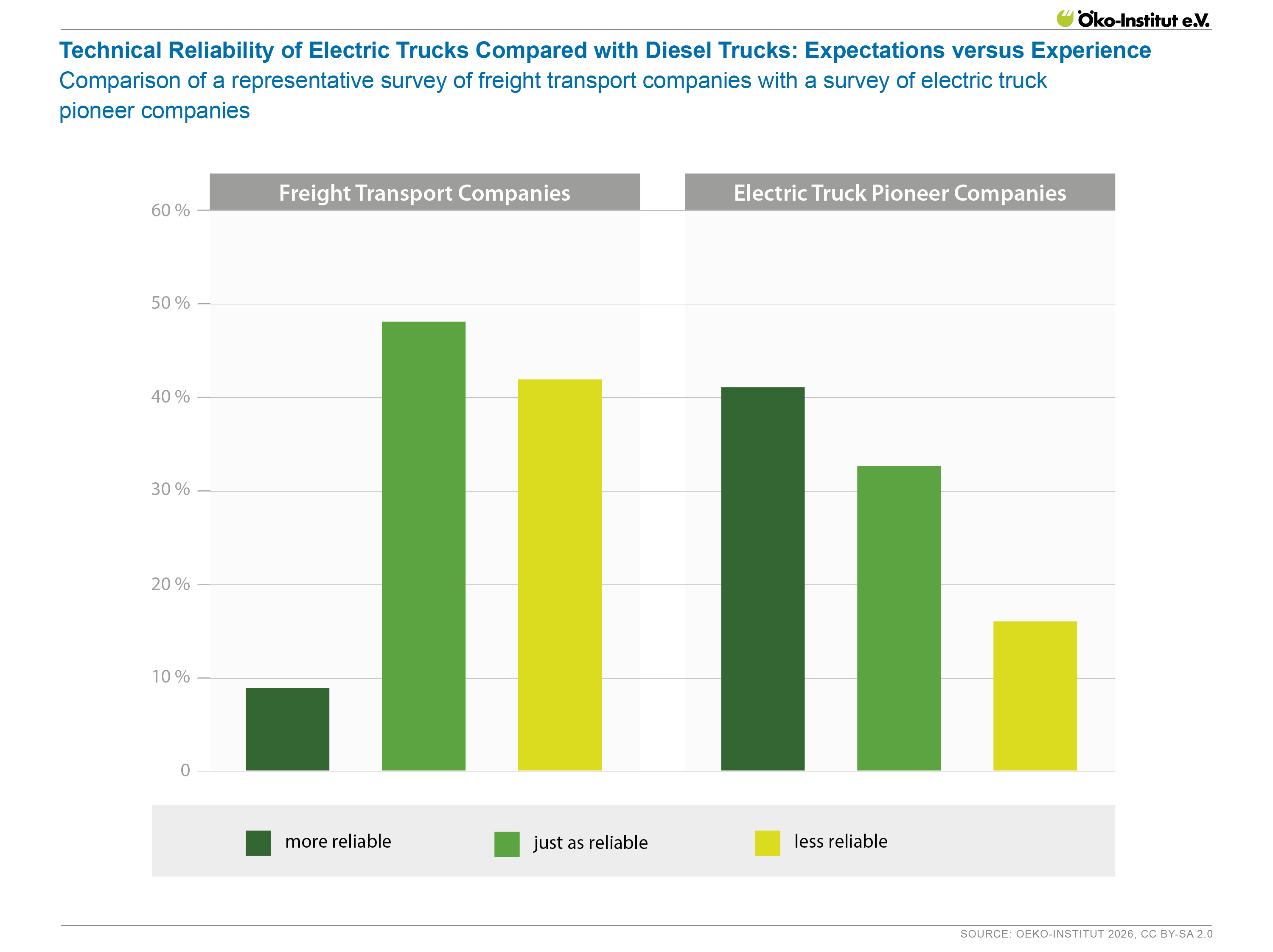
  • The graphic compares transport companies’ expectations of the technical reliability of e-trucks with the experiences of e-truck pioneer companies. Among transport companies, around 9 percent expect e-trucks to be more reliable than diesel trucks, around 48 percent expect them to be equally reliable, and around 42 percent expect them to be less reliable. Among e-truck pioneer companies, by contrast, around 41 percent report that e-trucks are more reliable than diesel trucks, around 33 percent see them as equally reliable, and only around 16 percent rate them as less reliable.

    Electric trucks in the >16/18-tonne class have only been available as production models for a few years. Nevertheless, pioneering electric truck operators are already rating the reliability of these vehicles very highly – and generally consider them to be even more technically reliable than comparable diesel trucks. Transport companies with no relevant practical experience of electric trucks have a very different view of their reliability. Only a small minority expect electric trucks to be more reliable in day-to-day operation.
    These significant differences illustrate the ‘experience gap’ and the importance of knowledge transfer between pioneers and the wider industry in the current market phase for the successful market ramp-up of electric trucks.
    Further information can be found study ‘Between Orientation and Optimization: The Status Quo and Perspectives of Battery-Electric Trucks in the Transport Industry 8https://www.oeko.de/fileadmin/oekodoc/ELV-Live_Between-Orientation-and-Optimization.pdf) . by Oeko-Institut

    Technical Reliability of Electric Trucks

    Image07/01/2026
    Electric trucks in the >16/18-tonne class have only been available as production models for a few years. Nevertheless, pioneering electric truck operators are already rating the reliability of these vehicles very highly – and generally consider them to be even more technically reliable than comparable diesel trucks.
  • The graphic shows assessments of the market relevance of alternative truck drivetrains and fuels for 2030. It compares the transport sector with e-truck pioneer companies. In the transport sector, the expected market relevance of e-trucks rises from around 1.6 to 2.0 points between 2021 and 2025. Hydrogen trucks, by contrast, are rated lower than in 2021. Biofuels, natural gas and e-fuels are rated lower or in the mid-range in 2025. Among e-truck pioneer companies, e-trucks are rated by far the most relevant option in 2024 and 2026, increasing from around 2.2 to 2.4 points. All other options — hydrogen, biofuels, natural gas and e-fuels — are rated significantly lower, mostly below 1 point.

    Hydrogen-based propulsion options are set to lose significant ground in terms of market significance by 2030. Whilst electricity-based fuels, biofuels and natural gas continue to be viewed as possible complementary options, their potential is considered to be significantly lower than that of battery-electric propulsion systems.
    In this general assessment, the sector as a whole and the pioneering companies with experience of electric trucks paint a very similar picture. It is striking, however, that companies already operating electric trucks view the market prospects for electric trucks with considerably greater optimism and regard the other alternatives with considerably greater pessimism than the sector as a whole. The positive experiences gained from real-world vehicle operation appear to be convincing. The high level of technical reliability, driver acceptance and the increasing suitability for regional and long-distance transport are giving the pioneering companies cause for confidence.
    At the same time, the continued market ramp-up remains closely linked to economic conditions, the expansion of the charging infrastructure and regulatory planning certainty.
    Further information can be found study ‘Between Orientation and Optimization: The Status Quo and Perspectives of Battery-Electric Trucks in the Transport Industry (<a href="https://www.oeko.de/fileadmin/oekodoc/ELV-Live_Between-Orientation-and-Optimization.pdf" rel="noreferrer nofollow">www.oeko.de/fileadmin/oekodoc/ELV-Live_Between-Orientatio...</a>). by Oeko-Institut

    Market Relevance for Alternative Truck Powertrains and Fuels

    Image07/01/2026
    Hydrogen-based propulsion options are set to lose significant ground in terms of market significance by 2030. Whilst electricity-based fuels, biofuels and natural gas continue to be viewed as possible complementary options, their potential is considered to be significantly lower than that of battery-electric propulsion systems.
  • More and more traction batteries for electromobility in the EU

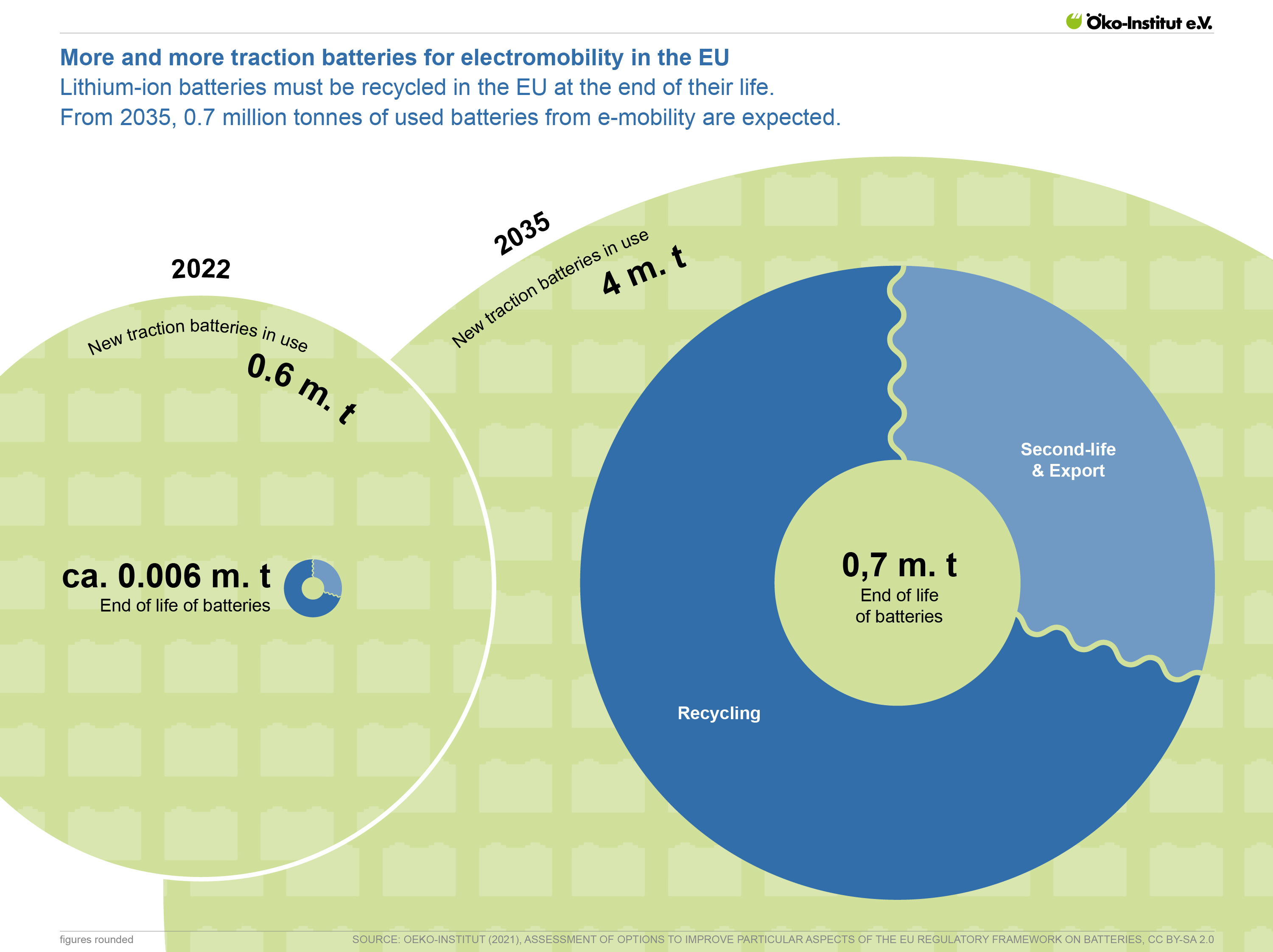
    In view of the currently rapidly growing number of used batteries from electric vehicles, buses and e-scooters, the question of proper end-of-life management is becoming more and more urgent (see infographic). Although recycling capacities are being built up in the EU, the logistics and recycling processes are usually associated with considerable costs.

    "There is currently a trend to 'donate' used batteries to other countries," says battery researcher Dr Johannes Betz of the Oeko-Institut. Many manufacturers argue that used batteries can still be used – for example in solar projects in Africa. More and more projects and press releases are praising this so-called repurposing approach as a solution. "Repurposing of used Li-ion batteries can certainly yield many environmental benefits”, says Betz. "But it is hard to understand why the focus is on shipping old batteries to low- and middle-income countries, given the great need for electricity storage in Germany and the EU”.

    More and more traction batteries for electromobility in the EU

    Image06/15/2022
    In view of the currently rapidly growing number of used batteries from electric vehicles, buses and e-scooters, the question of proper end-of-life management is becoming more and more urgent (see infographic). Although recycling capacities are being built up in the EU, the logistics and recycling processes are usually associated with considerable costs.