Focus

Products and technologies

[Translate to English:] © plainpicture / Tuomo Vainamo

Housing, mobility, food, clothing – private consumption accounts for a significant share of climate-harming greenhouse gas emissions. In addition to its use of energy resources, private consumption in Germany appropriates vast quantities of materials and resources worldwide. However, ever-increasing numbers of consumers are keen to make more conscious choices and are looking for the most energy-efficient, eco-friendly and healthy products, ideally manufactured in compliance with social standards. Quality marks and labels provide guidance here: they help consumers to shop with a conscience. When developing and introducing new technologies, too, it is important to weigh up the benefits and drawbacks from a broad sustainability perspective.

Researchers at the Oeko-Institut are involved in developing standards and criteria for product sustainability. They set out the minimum requirements relating to efficiency, durability, repairability and other environmental aspects of products and advise policy-makers on their introduction and procurement. They also look at requirements relating to the sustainable use of new materials and technologies and share their expertise during the development of new products and processes.

News

Infographics

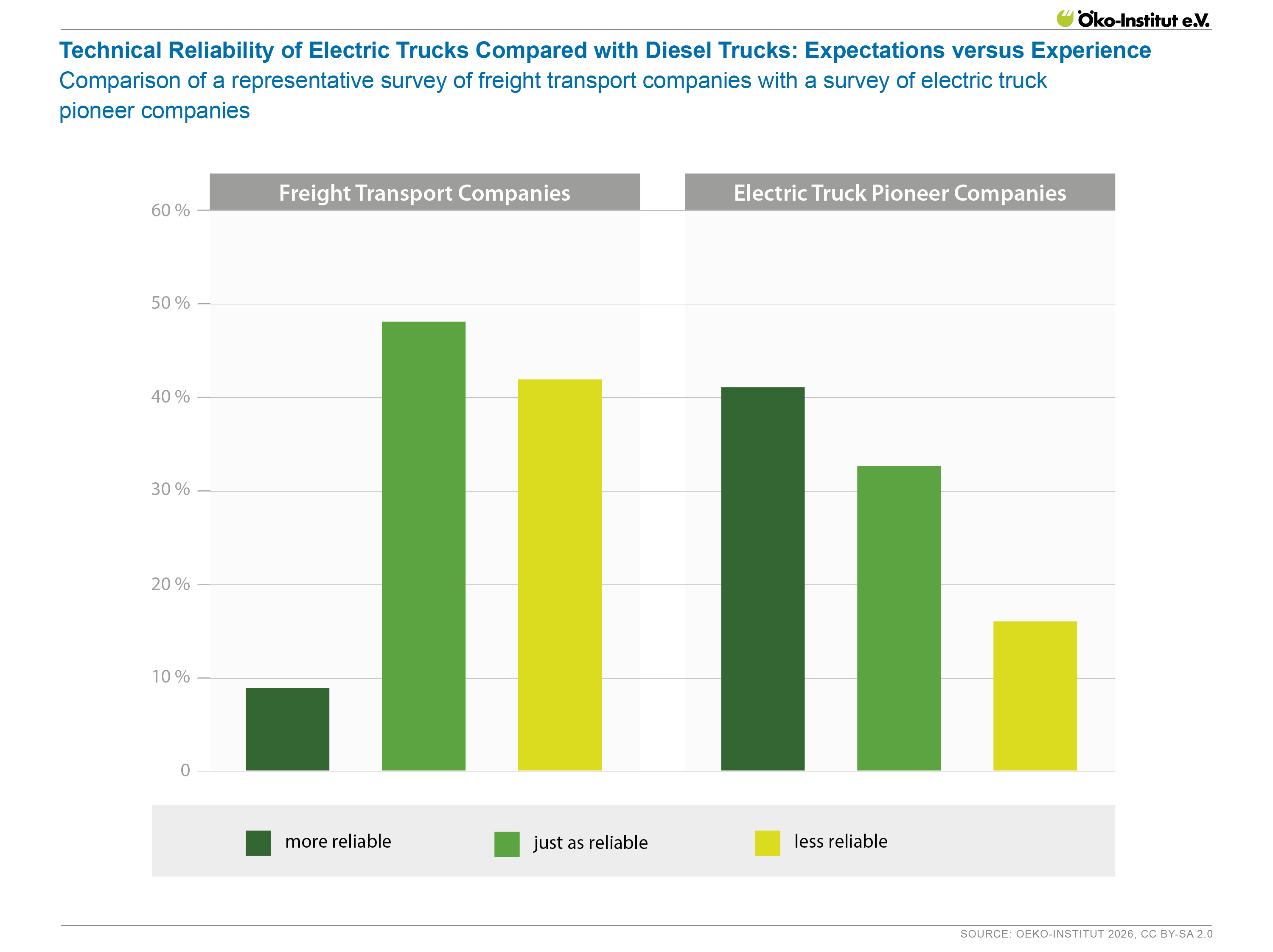
  • The graphic compares transport companies’ expectations of the technical reliability of e-trucks with the experiences of e-truck pioneer companies. Among transport companies, around 9 percent expect e-trucks to be more reliable than diesel trucks, around 48 percent expect them to be equally reliable, and around 42 percent expect them to be less reliable. Among e-truck pioneer companies, by contrast, around 41 percent report that e-trucks are more reliable than diesel trucks, around 33 percent see them as equally reliable, and only around 16 percent rate them as less reliable.

    Electric trucks in the >16/18-tonne class have only been available as production models for a few years. Nevertheless, pioneering electric truck operators are already rating the reliability of these vehicles very highly – and generally consider them to be even more technically reliable than comparable diesel trucks. Transport companies with no relevant practical experience of electric trucks have a very different view of their reliability. Only a small minority expect electric trucks to be more reliable in day-to-day operation.
    These significant differences illustrate the ‘experience gap’ and the importance of knowledge transfer between pioneers and the wider industry in the current market phase for the successful market ramp-up of electric trucks.
    Further information can be found study ‘Between Orientation and Optimization: The Status Quo and Perspectives of Battery-Electric Trucks in the Transport Industry 8https://www.oeko.de/fileadmin/oekodoc/ELV-Live_Between-Orientation-and-Optimization.pdf) . by Oeko-Institut

    Technical Reliability of Electric Trucks

    Image07/01/2026
    Electric trucks in the >16/18-tonne class have only been available as production models for a few years. Nevertheless, pioneering electric truck operators are already rating the reliability of these vehicles very highly – and generally consider them to be even more technically reliable than comparable diesel trucks.
  • The graphic shows assessments of the market relevance of alternative truck drivetrains and fuels for 2030. It compares the transport sector with e-truck pioneer companies. In the transport sector, the expected market relevance of e-trucks rises from around 1.6 to 2.0 points between 2021 and 2025. Hydrogen trucks, by contrast, are rated lower than in 2021. Biofuels, natural gas and e-fuels are rated lower or in the mid-range in 2025. Among e-truck pioneer companies, e-trucks are rated by far the most relevant option in 2024 and 2026, increasing from around 2.2 to 2.4 points. All other options — hydrogen, biofuels, natural gas and e-fuels — are rated significantly lower, mostly below 1 point.

    Hydrogen-based propulsion options are set to lose significant ground in terms of market significance by 2030. Whilst electricity-based fuels, biofuels and natural gas continue to be viewed as possible complementary options, their potential is considered to be significantly lower than that of battery-electric propulsion systems.
    In this general assessment, the sector as a whole and the pioneering companies with experience of electric trucks paint a very similar picture. It is striking, however, that companies already operating electric trucks view the market prospects for electric trucks with considerably greater optimism and regard the other alternatives with considerably greater pessimism than the sector as a whole. The positive experiences gained from real-world vehicle operation appear to be convincing. The high level of technical reliability, driver acceptance and the increasing suitability for regional and long-distance transport are giving the pioneering companies cause for confidence.
    At the same time, the continued market ramp-up remains closely linked to economic conditions, the expansion of the charging infrastructure and regulatory planning certainty.
    Further information can be found study ‘Between Orientation and Optimization: The Status Quo and Perspectives of Battery-Electric Trucks in the Transport Industry (<a href="https://www.oeko.de/fileadmin/oekodoc/ELV-Live_Between-Orientation-and-Optimization.pdf" rel="noreferrer nofollow">www.oeko.de/fileadmin/oekodoc/ELV-Live_Between-Orientatio...</a>). by Oeko-Institut

    Market Relevance for Alternative Truck Powertrains and Fuels

    Image07/01/2026
    Hydrogen-based propulsion options are set to lose significant ground in terms of market significance by 2030. Whilst electricity-based fuels, biofuels and natural gas continue to be viewed as possible complementary options, their potential is considered to be significantly lower than that of battery-electric propulsion systems.
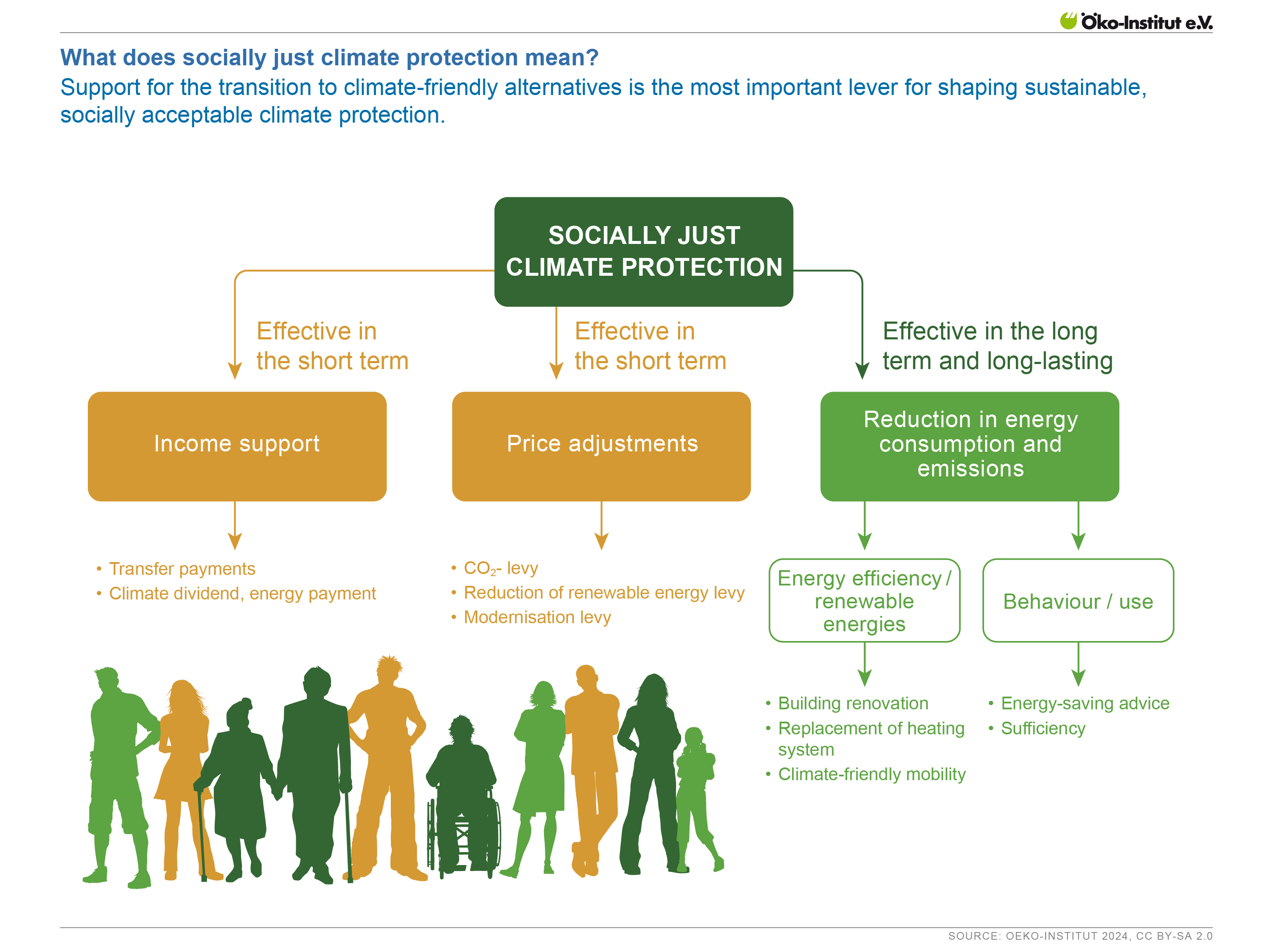
  • Infographic from Öko-Institut e.V. titled "What does socially just climate protection mean?" showing strategies for sustainable, socially acceptable climate protection. Central box labeled "Socially Just Climate Protection" connects to three approaches:  Income support (short-term):  Includes transfer payments, climate dividends, and energy payments.  Price adjustments (short-term):  Includes CO₂ levy, reduction of renewable energy levy, and modernization levy.  Reduction in energy consumption and emissions (long-term and lasting):  Split into two areas:  Energy efficiency / renewable energies: building renovation, heating system replacement, climate-friendly mobility.  Behaviour / use: energy-saving advice and sufficiency.  Silhouettes of diverse people are shown at the bottom, representing the inclusive impact of these measures.

    What does socially just climate protection mean? Support for the transition to climate-friendly alternatives is the most important lever for shaping sustainable, socially acceptable climate protection.

    What does socially just climate protection mean?

    Image10/21/2025
    What does socially just climate protection mean? Support for the transition to climate-friendly alternatives is the most important lever for shaping sustainable, socially acceptable climate protection.