Focus

Raw materials and mining

© plainpicture / Melanka Helms

Resource extraction is always associated with interventions in the natural environment and has major environmental impacts in many mining regions. Depending on the type of mining, it leads to large-scale reshaping of the natural environment, loss of ecosystems, changes in the water balance and pollution of soil, air, groundwater and surface waters. This applies particularly to the extraction of abiotic primary raw materials such as ores, coal, industrial minerals, natural stones, gravel and sand. At the same time, due to growing demand for raw materials, mining is making increasing inroads into undeveloped, environmentally sensitive areas.

The Oeko-Institut assesses the environmental hazard potential of raw materials and mining projects. It undertakes initial project assessments and provides guidance on raw materials-related prioritisation from an environmental perspective. The experts produce information on mining-specific environmental problems and develop potential countermeasures. In doing so, they close methodological and data-related gaps, particularly in resource extraction and processing – the steps in the production chain that impact most directly upon nature.

News

Infographics

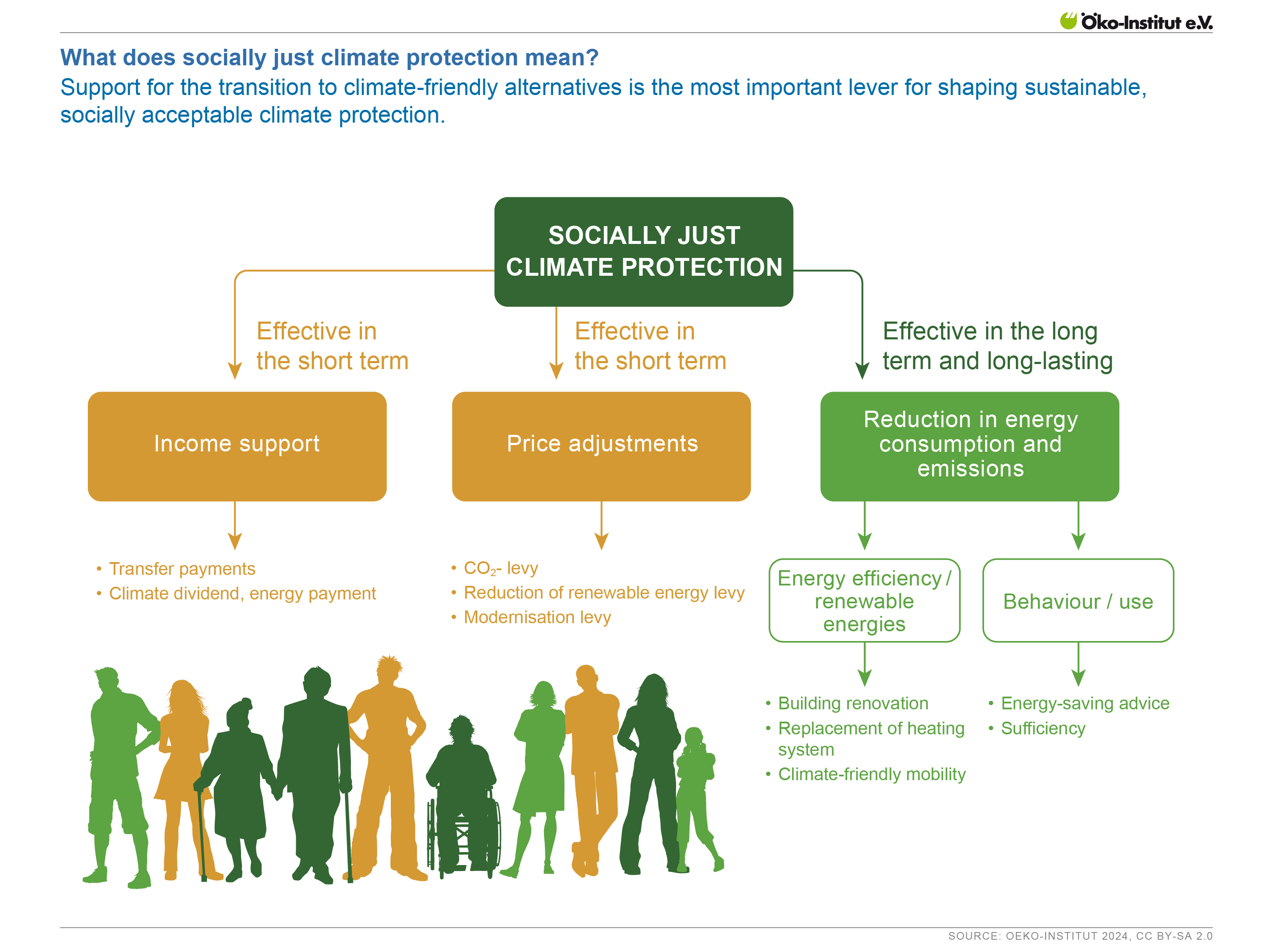
  • Infographic from Öko-Institut e.V. titled "What does socially just climate protection mean?" showing strategies for sustainable, socially acceptable climate protection. Central box labeled "Socially Just Climate Protection" connects to three approaches:  Income support (short-term):  Includes transfer payments, climate dividends, and energy payments.  Price adjustments (short-term):  Includes CO₂ levy, reduction of renewable energy levy, and modernization levy.  Reduction in energy consumption and emissions (long-term and lasting):  Split into two areas:  Energy efficiency / renewable energies: building renovation, heating system replacement, climate-friendly mobility.  Behaviour / use: energy-saving advice and sufficiency.  Silhouettes of diverse people are shown at the bottom, representing the inclusive impact of these measures.

    What does socially just climate protection mean?

    Image10/21/2025
    What does socially just climate protection mean? Support for the transition to climate-friendly alternatives is the most important lever for shaping sustainable, socially acceptable climate protection.
  • The twelve largest chemical parks in German industry

    Image07/08/2024
    The twelve largest German chemical parks generated 23 million tonnes of CO2 (mt CO2) in 2022, which corresponds to three percent of German greenhouse gas emissions.
  • Coastal Ecosystems: Blue Carbon Storage

    Image05/29/2024
    Seagrass meadows, mangrove forests and salt marshes can absorb and store up to 216 million tons of carbon from the atmosphere worldwide every year. Over centuries to millennia, they form an enormous carbon store of up to 22,000 million tons of carbon in marine sediment. At the same time, they make an important contribution to the preservation of biodiversity in the oceans and on the coasts, help to protect against storm surges and coastal protection and thus contribute to the nutrition and safety of millions of people. This is shown in a research report by the Öko-Institut and the Leibniz Center for Tropical Marine Research commissioned by the German Environment Agency, which examines the importance of coastal ecosystems for global climate protection.