Focus

Climate and energy law

© plainpicture / Christoph Eberl

With the adoption of the Paris Agreement in 2015, Germany pledged to achieve substantial reductions in its greenhouse gas emissions. In the Federal Climate Change Act and the Climate Action Plan, the German government set more detailed climate targets: the medium-term goal is to cut greenhouse gas emissions in Germany by 65% by 2030 compared to 1990 levels. Germany aims to achieve climate neutrality by 2045. Corresponding mitigation targets and actions have therefore been identified for the energy, industry, transport, buildings, agriculture and waste sectors and for land use, land use change and forestry (LULUCF).

Climate and energy law is a longstanding focus of attention for the Oeko-Institut’s legal researchers, whose work involves analysing, developing and elaborating climate change mitigation measures. In many instances, the first step is to establish that there is a need for legislation; the researchers then explore the political and legislative scope and identify suitable regulatory pathways. Whether the topic is the coal phase-out, carbon pricing or the reform of EU emissions trading – the Oeko-Institut develops proposals which, besides being legally viable, are fit for purpose, effective and efficient and do not impose disproportionate burdens on those directly and indirectly affected.

News

Infographics

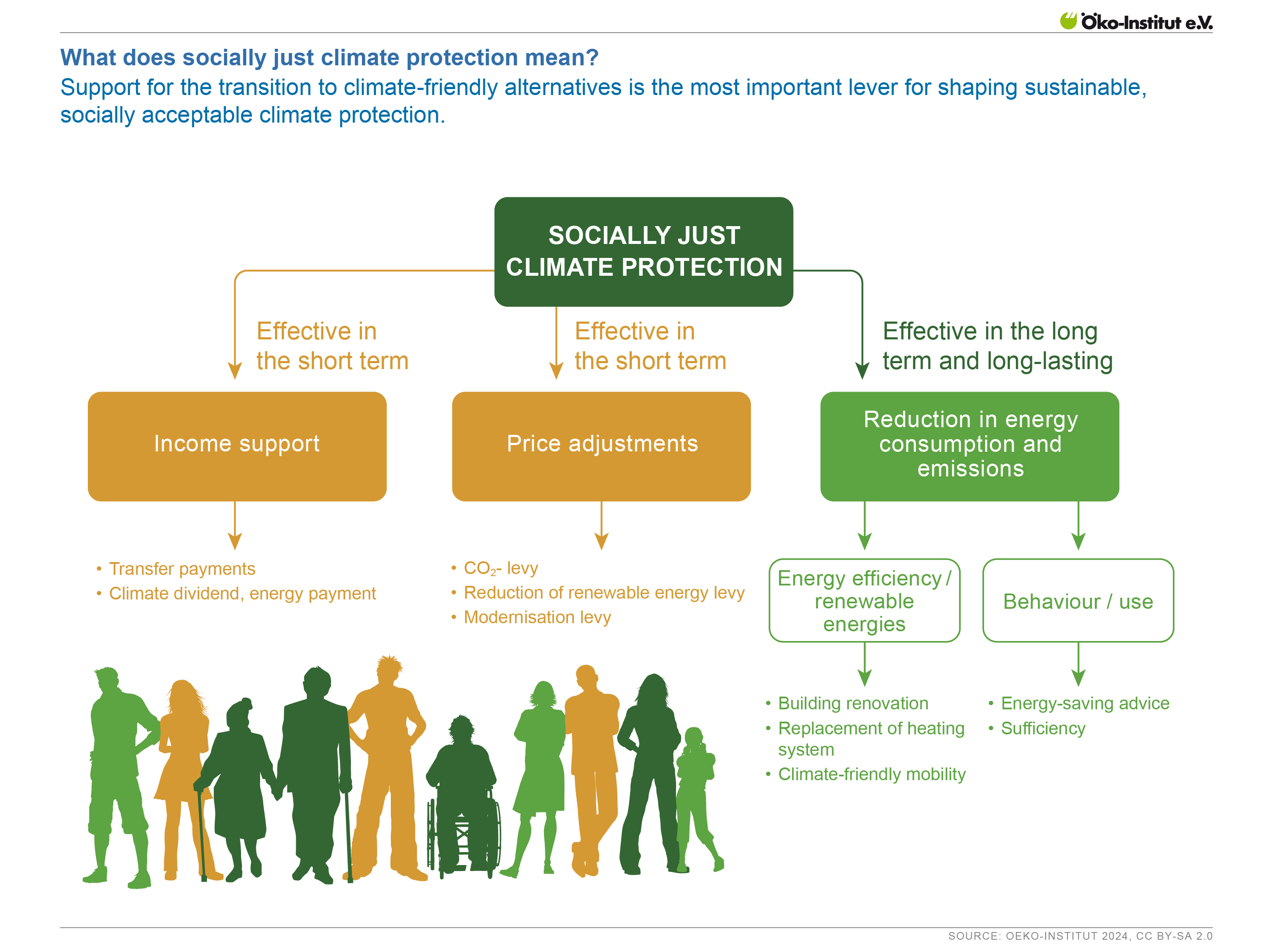
  • Infographic from Öko-Institut e.V. titled "What does socially just climate protection mean?" showing strategies for sustainable, socially acceptable climate protection. Central box labeled "Socially Just Climate Protection" connects to three approaches:  Income support (short-term):  Includes transfer payments, climate dividends, and energy payments.  Price adjustments (short-term):  Includes CO₂ levy, reduction of renewable energy levy, and modernization levy.  Reduction in energy consumption and emissions (long-term and lasting):  Split into two areas:  Energy efficiency / renewable energies: building renovation, heating system replacement, climate-friendly mobility.  Behaviour / use: energy-saving advice and sufficiency.  Silhouettes of diverse people are shown at the bottom, representing the inclusive impact of these measures.

    What does socially just climate protection mean?

    Image10/21/2025
    What does socially just climate protection mean? Support for the transition to climate-friendly alternatives is the most important lever for shaping sustainable, socially acceptable climate protection.
  • The twelve largest chemical parks in German industry

    Image07/08/2024
    The twelve largest German chemical parks generated 23 million tonnes of CO2 (mt CO2) in 2022, which corresponds to three percent of German greenhouse gas emissions.
  • Coastal Ecosystems: Blue Carbon Storage

    Image05/29/2024
    Seagrass meadows, mangrove forests and salt marshes can absorb and store up to 216 million tons of carbon from the atmosphere worldwide every year. Over centuries to millennia, they form an enormous carbon store of up to 22,000 million tons of carbon in marine sediment. At the same time, they make an important contribution to the preservation of biodiversity in the oceans and on the coasts, help to protect against storm surges and coastal protection and thus contribute to the nutrition and safety of millions of people. This is shown in a research report by the Öko-Institut and the Leibniz Center for Tropical Marine Research commissioned by the German Environment Agency, which examines the importance of coastal ecosystems for global climate protection.