Focus

Green transition of the heating sector

© plainpicture / Elisatim

Poorly insulated buildings and outdated heating systems use substantial amounts of energy. Overall, the buildings sector is responsible for around 25% of Germany’s carbon emissions and 30% of its final energy consumption. In order to meet the climate targets, the sector needs to become climate-neutral by 2045. Here, the aim is to achieve a 40% reduction in harmful greenhouse gas emissions by 2030 against the 2014 baseline.

Meeting these climate targets will require an ambitious upgrading programme and more intensive use of renewable energies. Above all, appropriate policy measures are required to deliver effective climate change mitigation in the buildings sector, as described by the Oeko-Institut in numerous studies. From the researchers’ perspective, simply providing funding for upgrading schemes is not enough. Ambitious emissions standards for buildings are also required, along with incentives and rules applicable to the conversion of existing heating systems to renewables, with a particular focus on heat pumps. Heat networks must be expanded and operated on the basis of renewables. Ways must also be found to limit the increase in living area and floor space. In addition, policy-makers have a responsibility to ensure that there is an adequate supply of well-qualified entrants to the crafts and trades so that skilled workers are available to provide renovation and retrofitting services.

News

Infographics

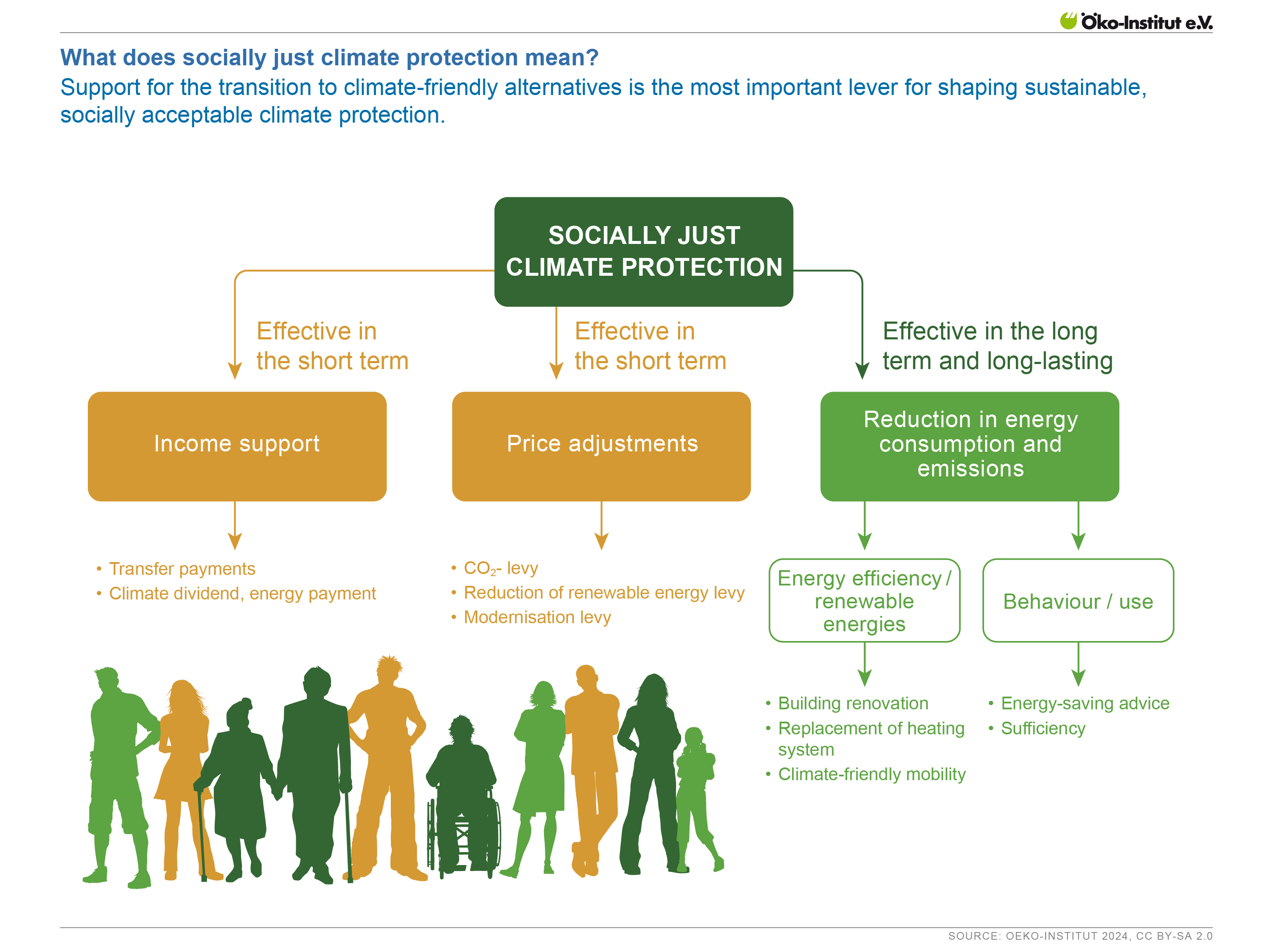
  • Infographic from Öko-Institut e.V. titled "What does socially just climate protection mean?" showing strategies for sustainable, socially acceptable climate protection. Central box labeled "Socially Just Climate Protection" connects to three approaches:  Income support (short-term):  Includes transfer payments, climate dividends, and energy payments.  Price adjustments (short-term):  Includes CO₂ levy, reduction of renewable energy levy, and modernization levy.  Reduction in energy consumption and emissions (long-term and lasting):  Split into two areas:  Energy efficiency / renewable energies: building renovation, heating system replacement, climate-friendly mobility.  Behaviour / use: energy-saving advice and sufficiency.  Silhouettes of diverse people are shown at the bottom, representing the inclusive impact of these measures.

    What does socially just climate protection mean?

    Image10/21/2025
    What does socially just climate protection mean? Support for the transition to climate-friendly alternatives is the most important lever for shaping sustainable, socially acceptable climate protection.
  • The twelve largest chemical parks in German industry

    Image07/08/2024
    The twelve largest German chemical parks generated 23 million tonnes of CO2 (mt CO2) in 2022, which corresponds to three percent of German greenhouse gas emissions.
  • Coastal Ecosystems: Blue Carbon Storage

    Image05/29/2024
    Seagrass meadows, mangrove forests and salt marshes can absorb and store up to 216 million tons of carbon from the atmosphere worldwide every year. Over centuries to millennia, they form an enormous carbon store of up to 22,000 million tons of carbon in marine sediment. At the same time, they make an important contribution to the preservation of biodiversity in the oceans and on the coasts, help to protect against storm surges and coastal protection and thus contribute to the nutrition and safety of millions of people. This is shown in a research report by the Öko-Institut and the Leibniz Center for Tropical Marine Research commissioned by the German Environment Agency, which examines the importance of coastal ecosystems for global climate protection.