Spenden
Focus

End devices

© plainpicture/Ake Nyqvis

The use of information and communication technologies (ICT) has been growing continuously for years. Digital terminal devices consume ever-increasing quantities of resources and energy. Rapid innovation cycles shorten the already brief lifetimes of electronic products and create a weighty energy and resource “backpack” at every stage in the lifecycle of digital terminals: from the manufacture of silicon chips to the transporting of raw materials and components, the use of IT products, including mobile devices such as laptops and smartphones, servers and storage facilities, and finally disposal.

The Oeko-Institut conducts sustainability assessments on a range of electronic products and identifies environmental impacts on a lifecycle basis. With these environmental audits, the experts create the frameworks for the identification and certification of low-impact products in the marketplace, for instance via ecolabels such as Blue Angel or the EU energy efficiency classification scheme. The Oeko-Institut also establishes a scientific basis for public procurement of IT products with improved environmental credentials.

Infographics

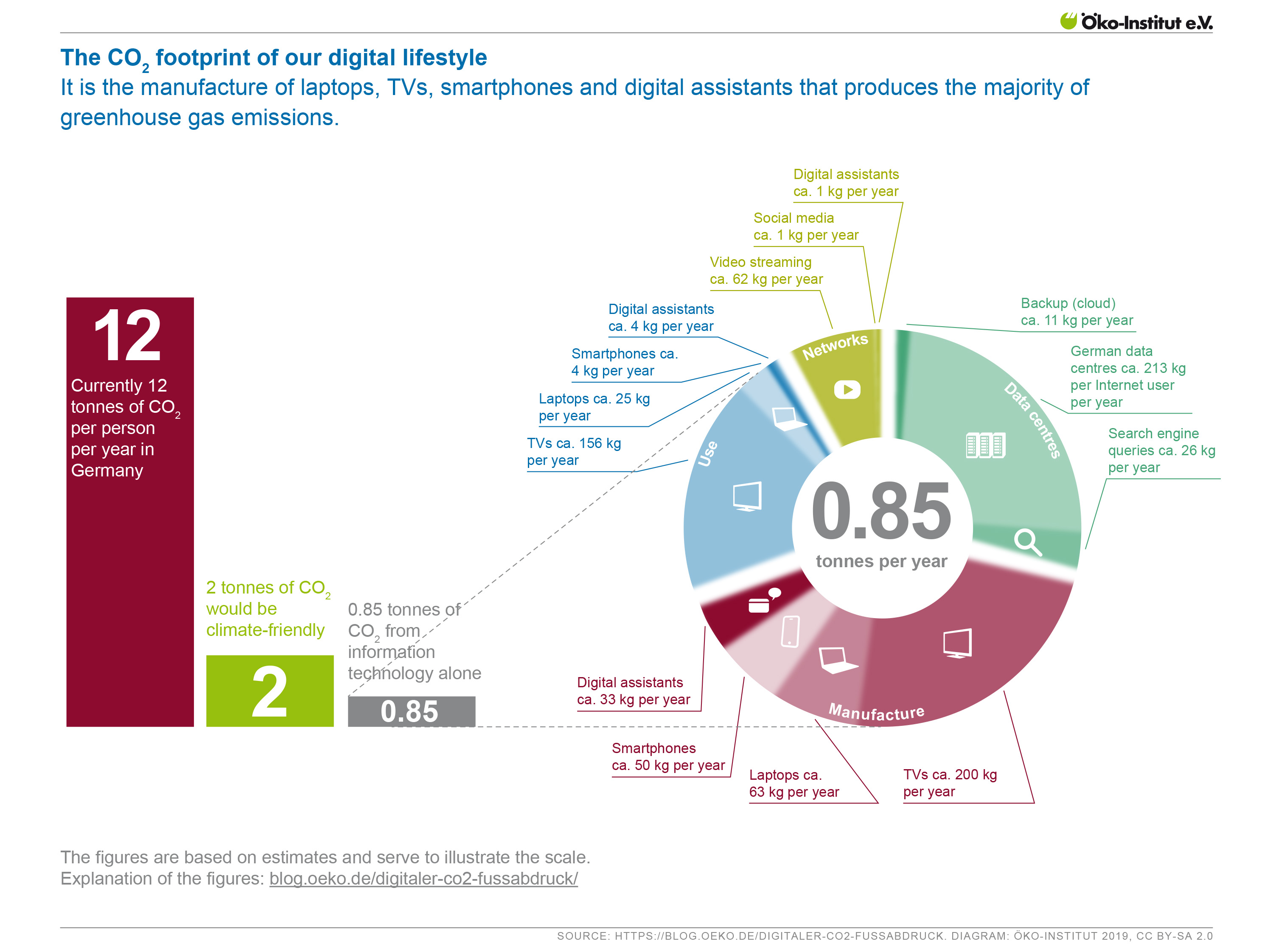
  • The CO2 footprint of our digital lifestyle

    What are the CO2 emissions of a Google search? In response to this popular question a researcher at the Oeko-Institut set out to calculate how digitalisation affects the climate – or at least illustrate the scale of the issue. The problem is that some of the figures are fraught with uncertainty – partly because they are changing rapidly as a result of technological progress and changing consumer habits and because they depend heavily on structural conditions (such as how the electricity is generated). Nevertheless, the researcher used some number games and “rule of three” calculations to demonstrate the scale of the problem. The figures were generously rounded to avoid pretending to a degree of accuracy that unfortunately does not exist.

    To give a general idea: through energy use, transport and consumption, someone living in Germany generates around 12 tonnes of CO2-equivalent emissions (CO2e) per year. A climate-friendly level would be two tonnes for every person on Earth.

    Link to a detailed blog post with all the facts: blog.oeko.de/digitaler-co2-fussabdruck/#english

    The CO2 footprint of our digital lifestyle

    Image04/27/2020
    What are the CO2 emissions of a Google search? In response to this popular question a researcher at the Oeko-Institut set out to calculate how digitalisation affects the climate – or at least illustrate the scale of the issue.