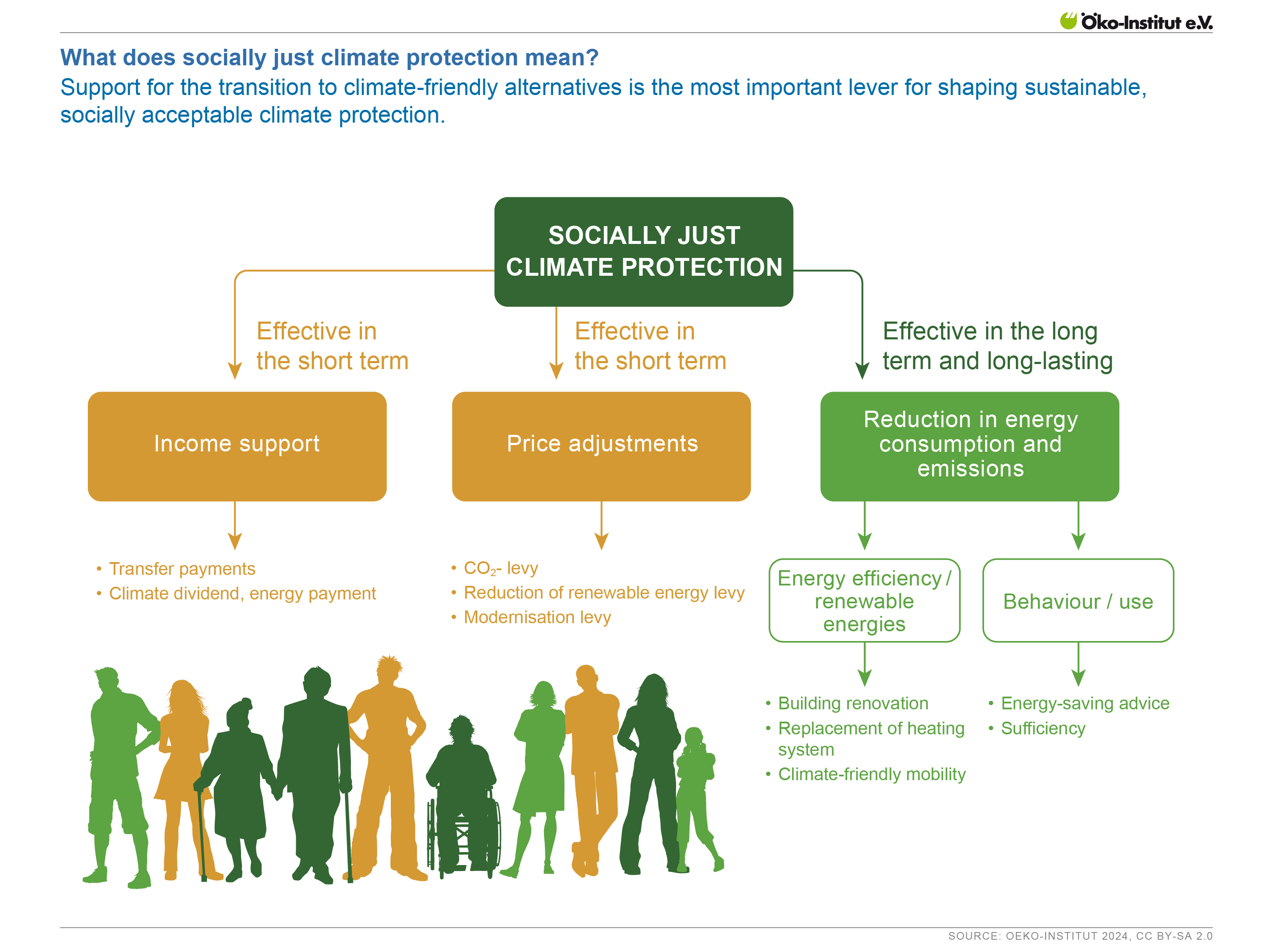
• Infographic from Öko-Institut e.V. titled "What does socially just climate protection mean?" showing strategies for sustainable, socially acceptable climate protection. Central box labeled "Socially Just Climate Protection" connects to three approaches:  Income support (short-term):  Includes transfer payments, climate dividends, and energy payments.  Price adjustments (short-term):  Includes CO₂ levy, reduction of renewable energy levy, and modernization levy.  Reduction in energy consumption and emissions (long-term and lasting):  Split into two areas:  Energy efficiency / renewable energies: building renovation, heating system replacement, climate-friendly mobility.  Behaviour / use: energy-saving advice and sufficiency.  Silhouettes of diverse people are shown at the bottom, representing the inclusive impact of these measures.

    What does socially just climate protection mean? Support for the transition to climate-friendly alternatives is the most important lever for shaping sustainable, socially acceptable climate protection.

    What does socially just climate protection mean?

    Image10/21/20251.29 MB
    What does socially just climate protection mean? Support for the transition to climate-friendly alternatives is the most important lever for shaping sustainable, socially acceptable climate protection.
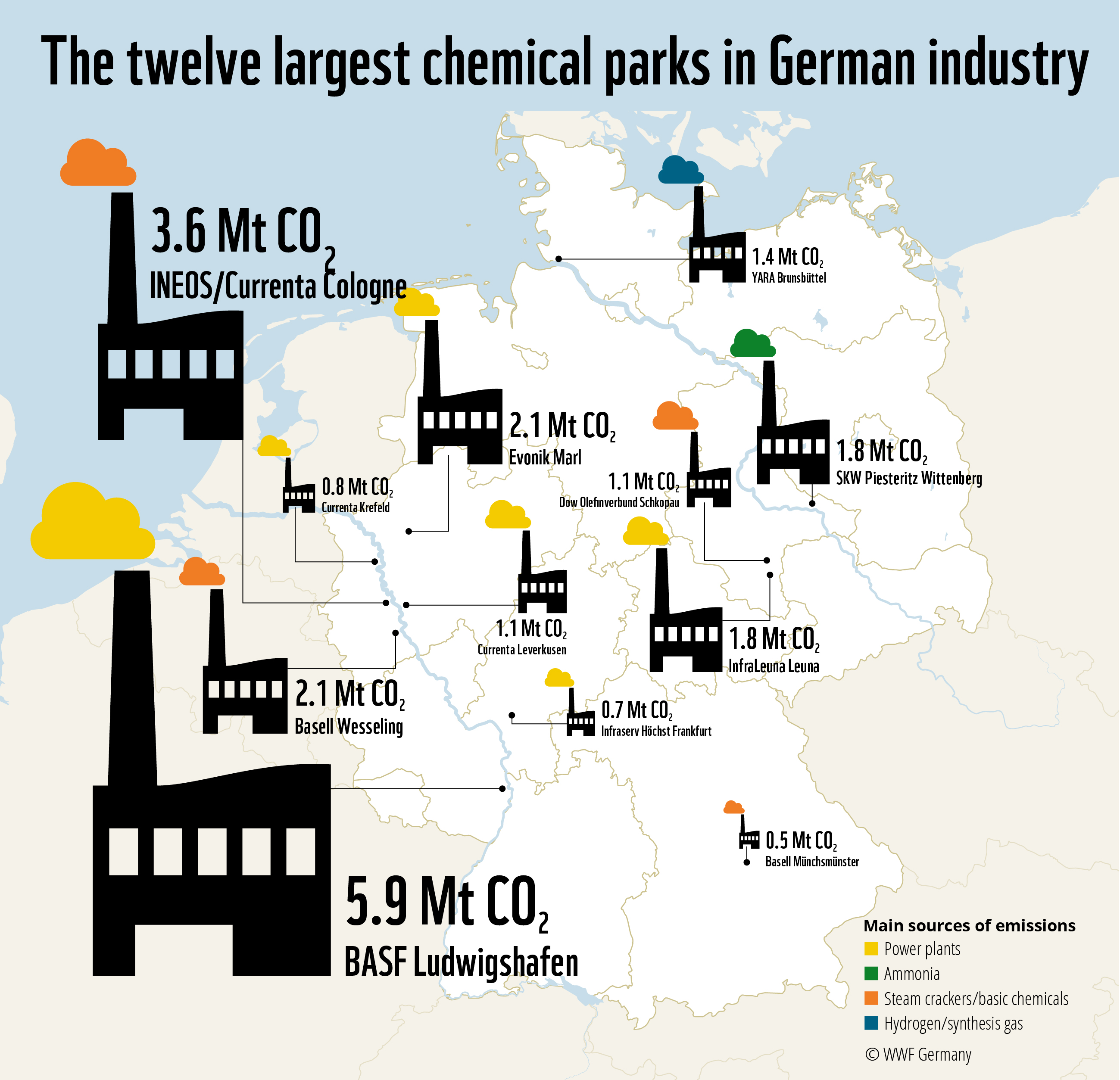
  • The twelve largest German chemical parks generated 23 million tonnes of CO2 (mt CO2) in 2022, which corresponds to three percent of German greenhouse gas emissions.

    The twelve largest chemical parks in German industry

    Image07/08/20241.23 MB
    The twelve largest German chemical parks generated 23 million tonnes of CO2 (mt CO2) in 2022, which corresponds to three percent of German greenhouse gas emissions.
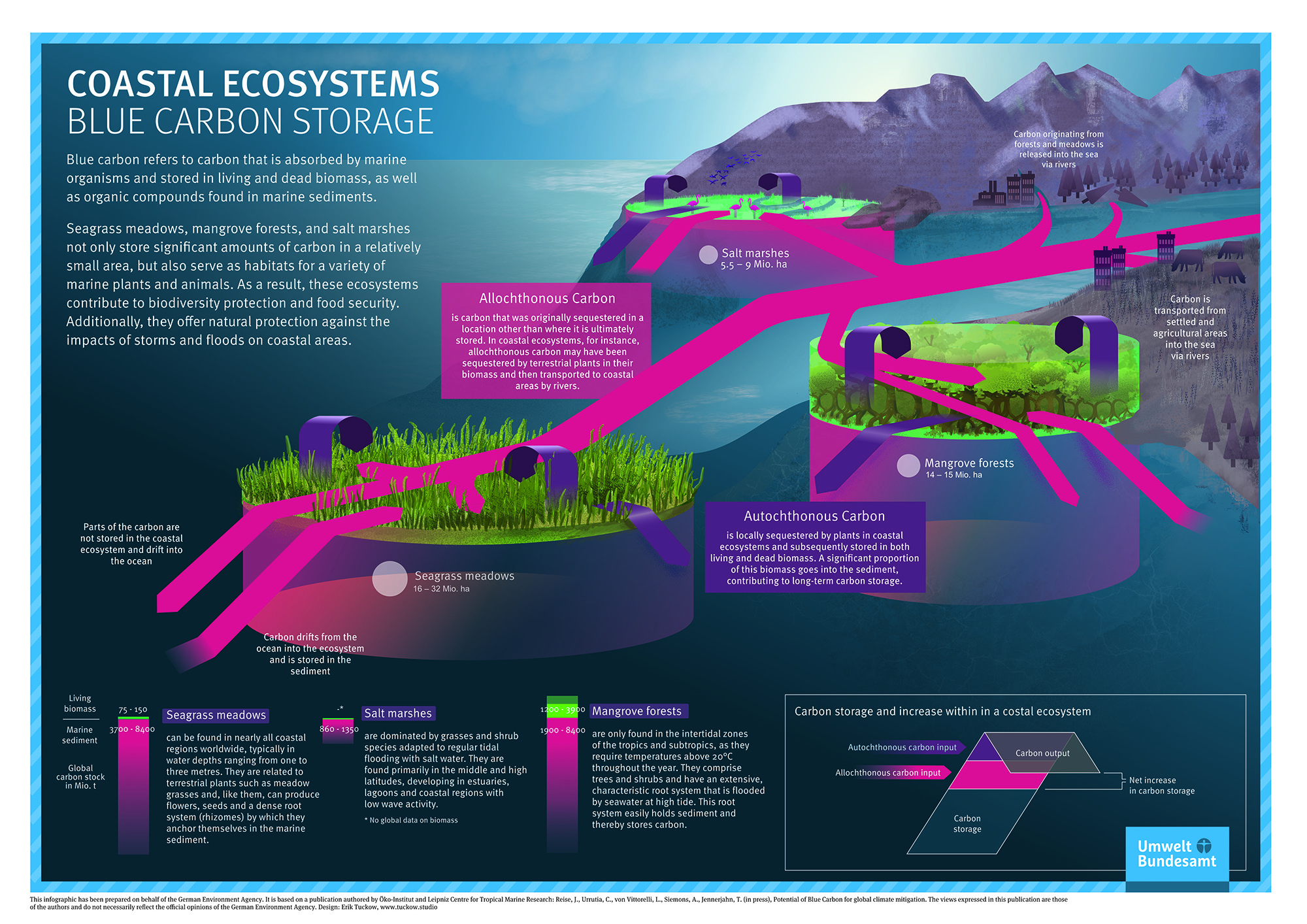
  • Seagrass meadows, mangrove forests and salt marshes can absorb and store up to 216 million tons of carbon from the atmosphere worldwide every year. Over centuries to millennia, they form an enormous carbon store of up to 22,000 million tons of carbon in marine sediment. At the same time, they make an important contribution to the preservation of biodiversity in the oceans and on the coasts, help to protect against storm surges and coastal protection and thus contribute to the nutrition and safety of millions of people. This is shown in a research report by the Öko-Institut and the Leibniz Center for Tropical Marine Research commissioned by the German Environment Agency, which examines the importance of coastal ecosystems for global climate protection.

    Coastal Ecosystems: Blue Carbon Storage

    Image05/29/20243.13 MB
    Seagrass meadows, mangrove forests and salt marshes can absorb and store up to 216 million tons of carbon from the atmosphere worldwide every year. Over centuries to millennia, they form an enormous carbon store of up to 22,000 million tons of carbon in marine sediment. At the same time, they make an important contribution to the preservation of biodiversity in the oceans and on the coasts, help to protect against storm surges and coastal protection and thus contribute to the nutrition and safety of millions of people. This is shown in a research report by the Öko-Institut and the Leibniz Center for Tropical Marine Research commissioned by the German Environment Agency, which examines the importance of coastal ecosystems for global climate protection.
  • Climate protection in the film production

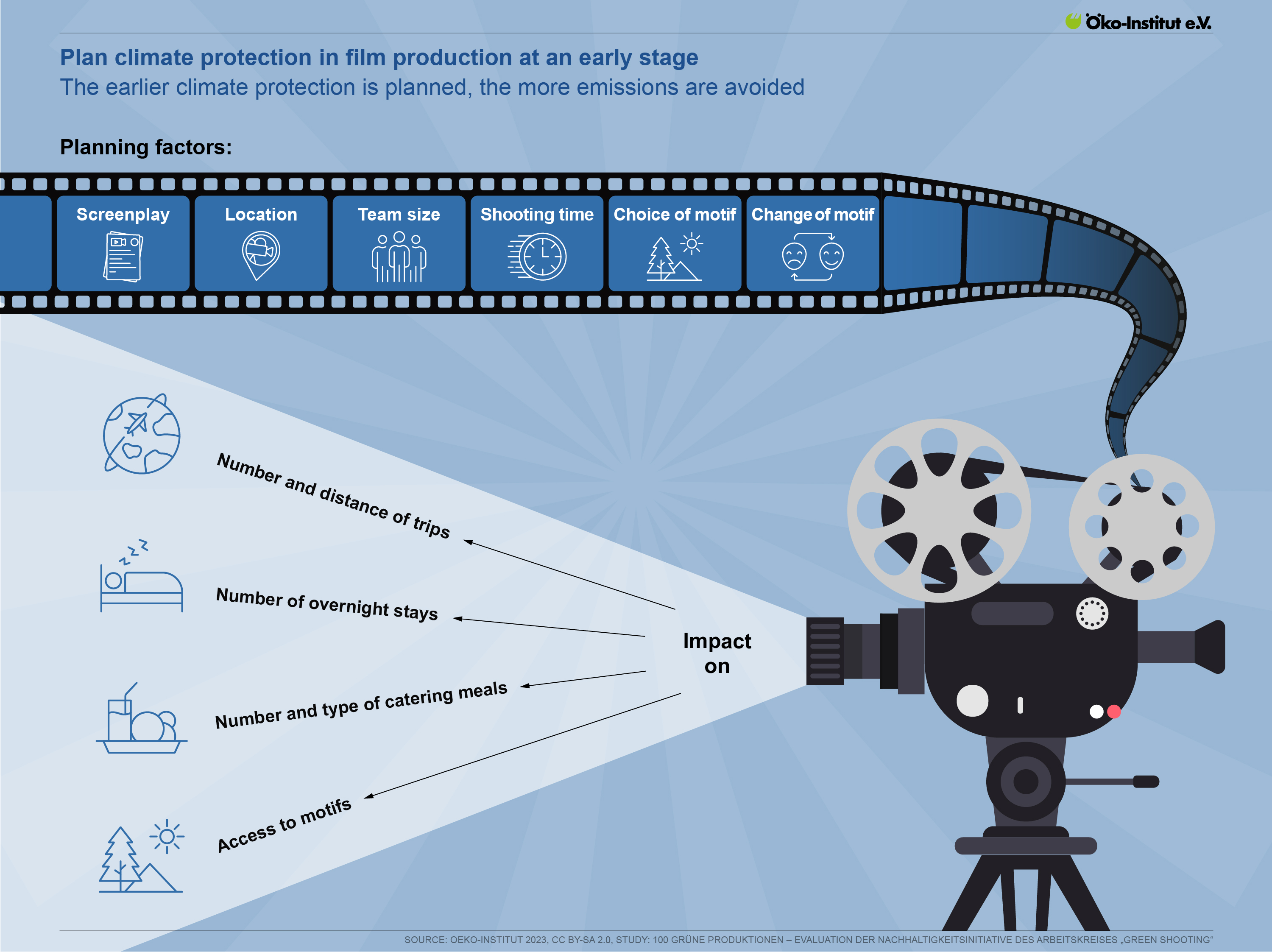
    The "travel and transport" sector accounts for the largest share of greenhouse gas emissions across all film formats. If emissions are to be reduced, the greatest success is achieved the earlier climate protection is planned into the preparation of a film and the effort and costs are taken into account. This applies both to strategic decisions about the filming location or the size of the team, but also to operational decisions, such as the selection of the caterer or the rental of vehicles.

    Climate protection in the film production

    Image03/28/20231.22 MB
    The "travel and transport" sector accounts for the largest share of greenhouse gas emissions across all film formats. If emissions are to be reduced, the greatest success is achieved the earlier climate protection is planned into the preparation of a film and the effort and costs are taken into account.
  • Different greenhouse gas emissions depending on film format

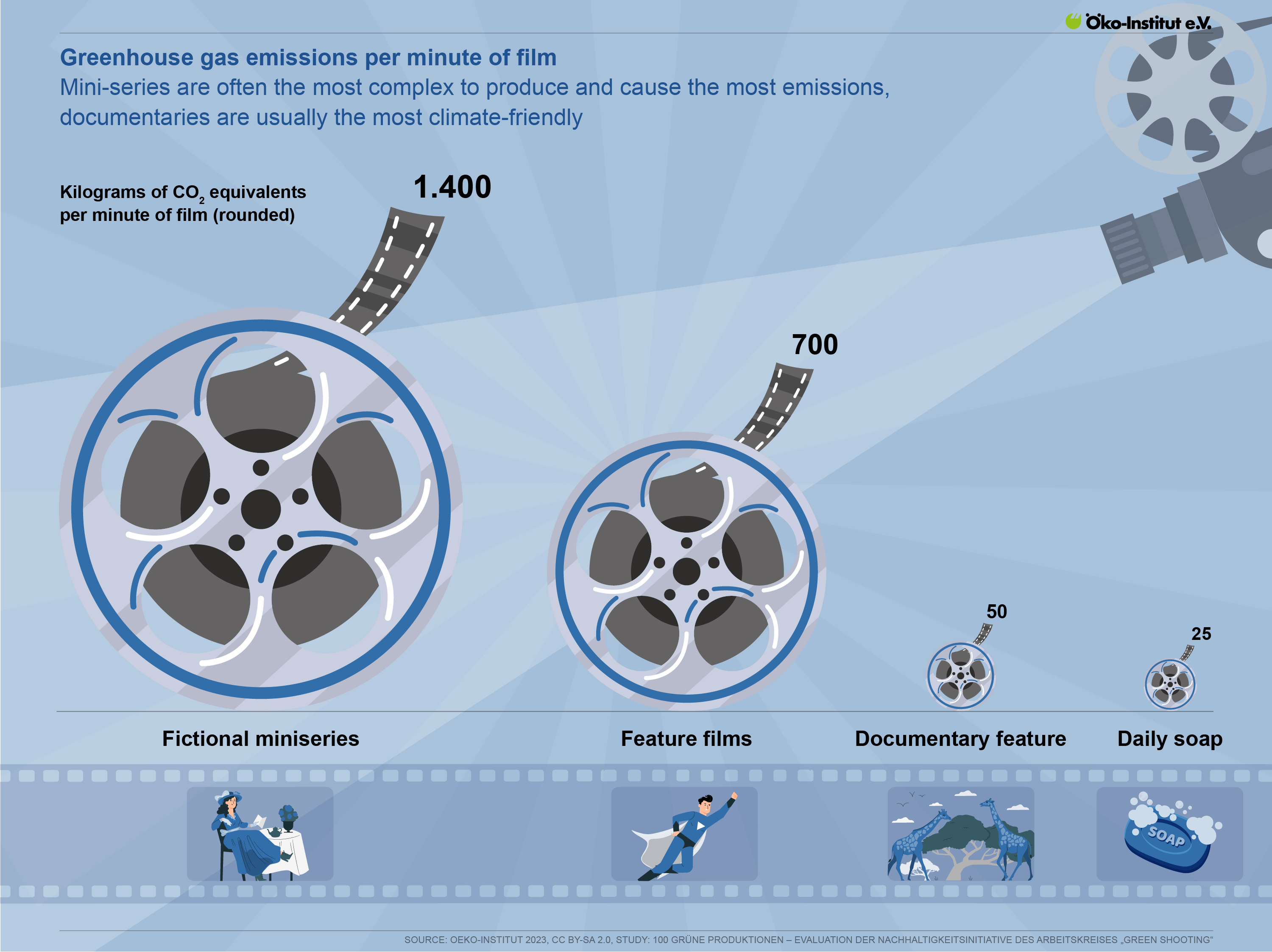
    Different film formats emit different amounts per minute of film produced: elaborate series and feature films emit more than daily soaps, documentaries or docu-series. For example, the production of one minute of a lavishly produced series (1,400 kilogrammes of CO2 equivalents (CO2e)) emits more than 50 times as much GHG as a documentary film (25 kilogrammes of CO2e).

    Different greenhouse gas emissions depending on film format

    Image03/28/20231.32 MB
    Different film formats emit different amounts per minute of film produced: elaborate series and feature films emit more than daily soaps, documentaries or docu-series.
  • Where CO2 emissions are generated in film production

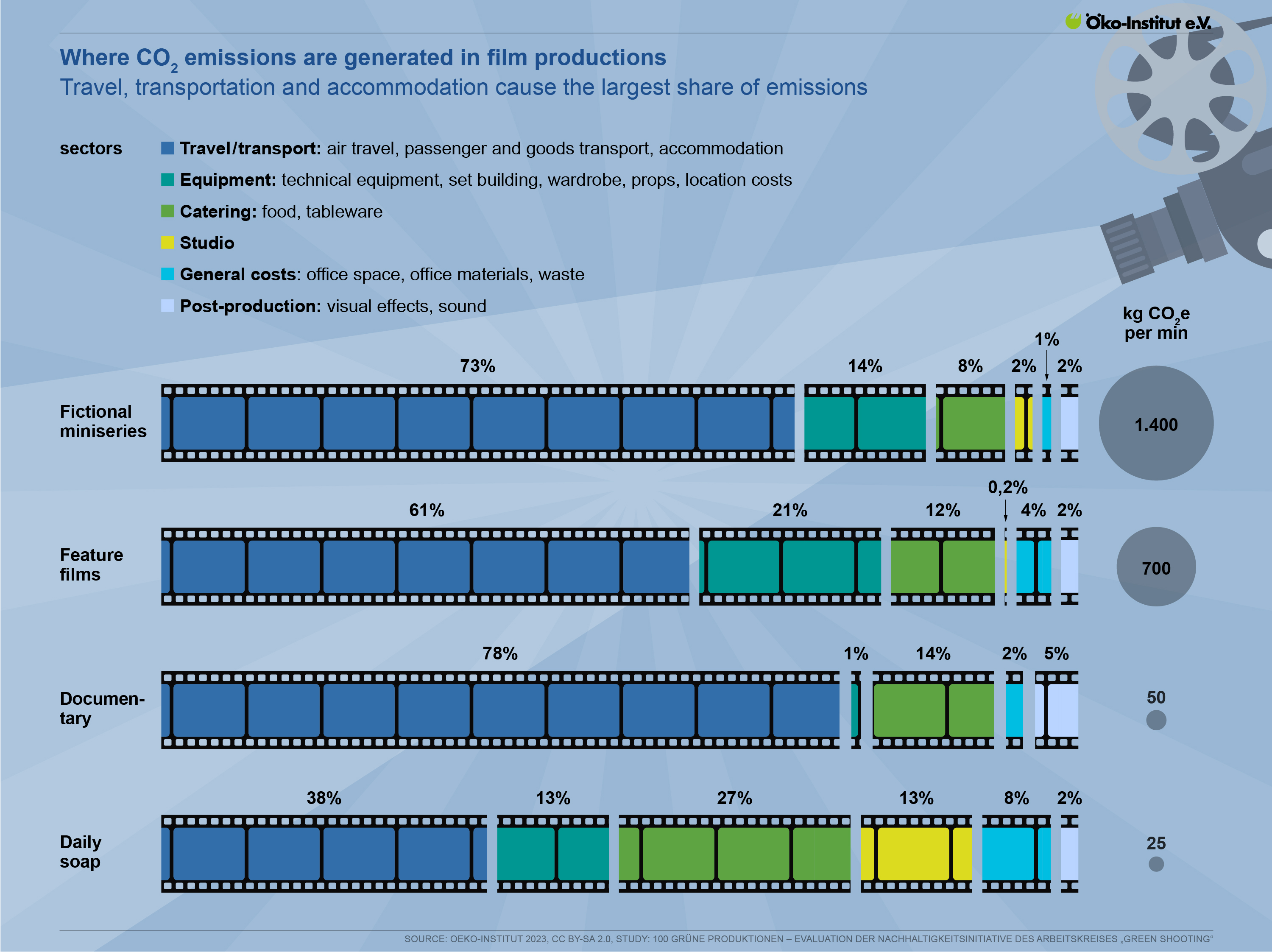
    The "travel and transport" sector accounts for the largest share of greenhouse gas emissions across all film formats, at 40 to 80 per cent. Equipment, catering and, in the case of daily soaps, space heating, air conditioning and studio lighting also account for a larger share. Long filming times do not necessarily mean more greenhouse gases are emitted. Background:
    For the first time, the greenhouse gas emissions of films and series were systematically analysed in a comprehensive study. The data for this came from 78 productions. The sustainability initiative emerged from the film industry. Its goal was to take climate impacts into account and reduce them in the future, right from the start of production. blog.oeko.de/gzsz-tatort-babylon-berlin-und-co-analyse-zeigt-grosses-klimaschutz-potenzial-bei-film-produktionen/

    Where CO2 emissions are generated in film production

    Image03/28/20231.52 MB
    The "travel and transport" sector accounts for the largest share of greenhouse gas emissions across all film formats, at 40 to 80 per cent. Equipment, catering and, in the case of daily soaps, space heating, air conditioning and studio lighting also account for a larger share.
  • Civilisation’s gold – the potential of urban mining

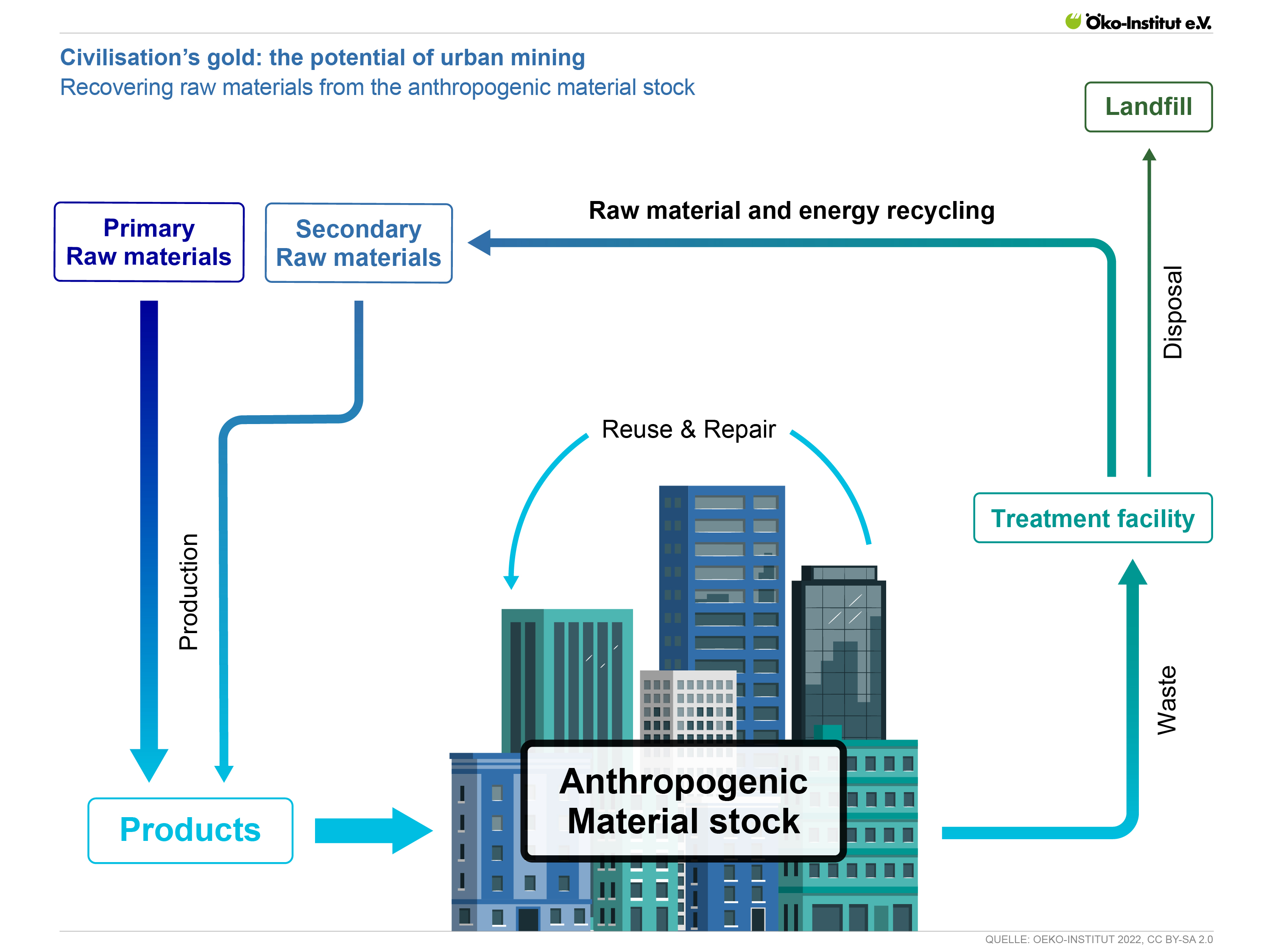
    This figure explains the urban mining cycle: the anthropogenic material stock – created by human activity – is the source of raw materials for future use. Waste products from this stock, such as cutlery, cables and passenger cars, are scrapped and taken to recycling plants. The non-recyclable components are sent to landfill, while the rest of the waste is recycled, with recovery of raw materials and energy. The secondary raw materials that are recovered can be processed into new products and are fed back into the anthropogenic material stock. At present, large quantities of new (i.e. newly extracted) primary raw materials are entering the production process. In future, a substantial proportion of such materials will come from the anthropogenic material stock itself.<br> Further information can be found in the blog article Civilisation’s gold: https://blog.oeko.de/civilisations-gold-first-ever-mapping-of-the-urban-mining-potential-to-2040/

    Civilisation’s gold – the potential of urban mining

    Image09/29/2022995.04 KB
    This figure explains the urban mining cycle: the anthropogenic material stock – created by human activity – is the source of raw materials for future use.
  • The anthropogenic metals stock is growing

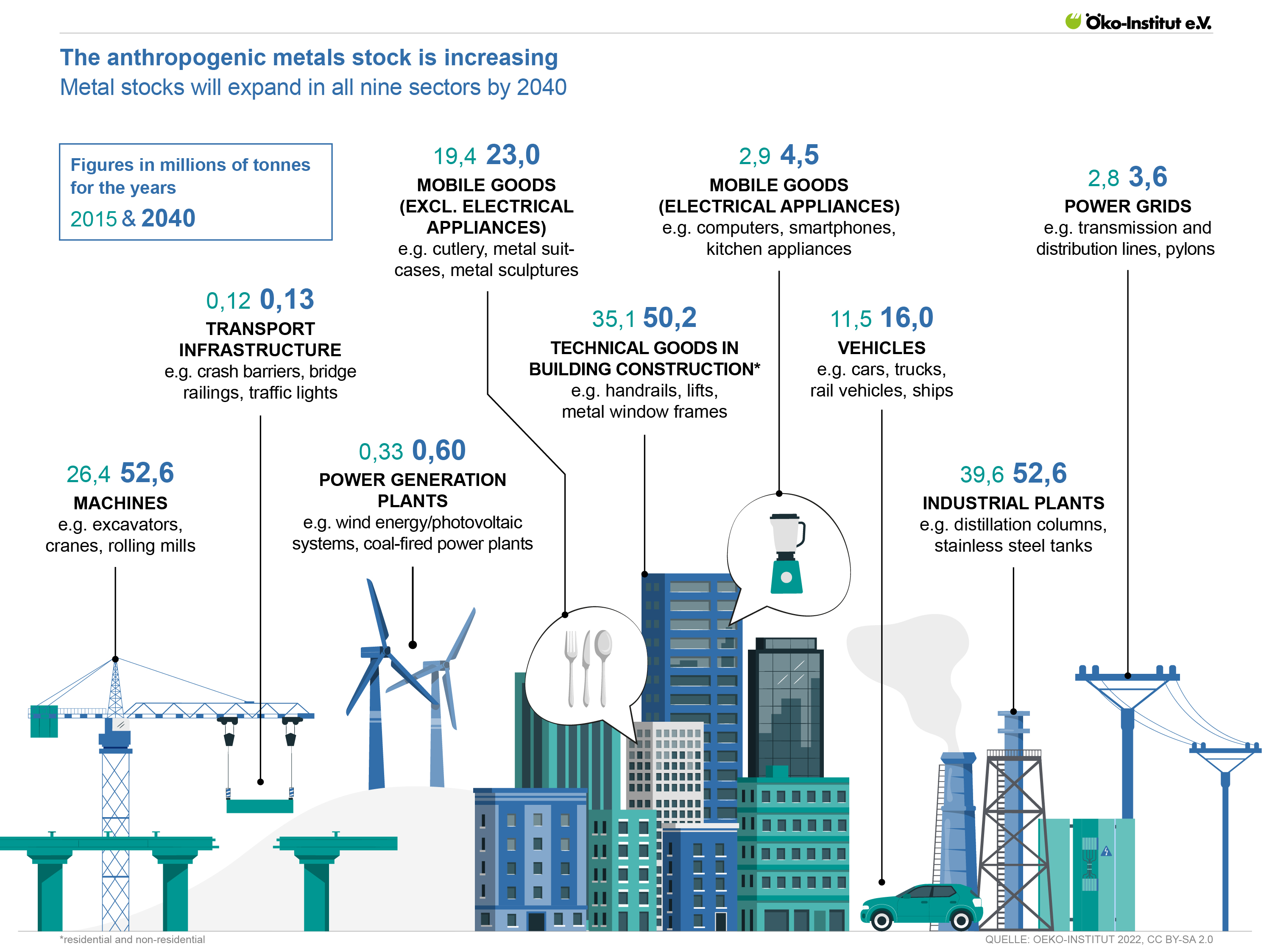
    This figure illustrates the anthropogenic metals stock. It is fed by nine sectors: technical goods in building construction, mobile goods in buildings (excluding electrical appliances), mobile goods in buildings (electrical appliances), power generation plants, power grids, vehicles, transport infrastructure, industrial plants, and machines. Researchers from the Oeko-Institut have now conducted the first-ever mapping of this stock, with a focus on the following metals: aluminium (non-ferrous metal); magnesium (non-ferrous metal); zinc (non-ferrous metal); tin (non-ferrous metal); stainless steel (non-ferrous metal); brass (alloy); neodymium-iron-boron magnetic materials / rare earths (alloy). As the stock of all these metals is set to increase substantially by 2040, it can serve as a source of raw materials in future.
    Further information can be found in the blog article Civilisation’s gold: https://blog.oeko.de/civilisations-gold-first-ever-mapping-of-the-urban-mining-potential-to-2040/

    The anthropogenic metals stock is growing

    Image09/29/20221.43 MB
    This figure illustrates the anthropogenic metals stock. It is fed by nine sectors: technical goods in building construction, mobile goods in buildings (excluding electrical appliances), mobile goods in buildings (electrical appliances), power generation plants, power grids, vehicles, transport infrastructure, industrial plants, and machines.
  • Urban mining – a future source of raw materials

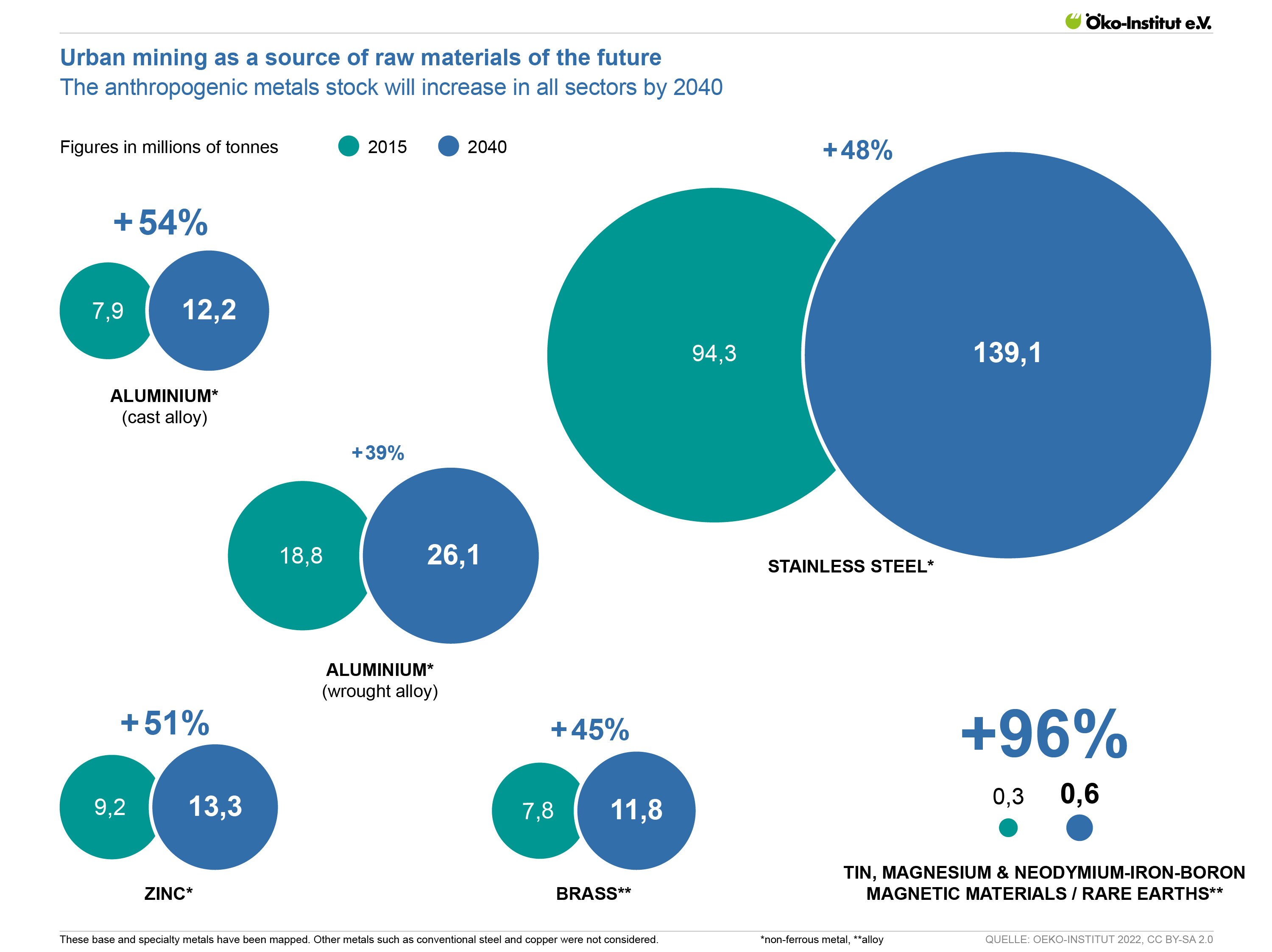
    This figure traces the growth of the various metals in the anthropogenic metals stock – which is created by human activity – to 2040. The stock of all the metals investigated (aluminium (non-ferrous metal); magnesium (non-ferrous metal); zinc (non-ferrous metal); tin (non-ferrous metal); stainless steel (non-ferrous metal); brass (alloy); neodymium-iron-boron magnetic materials / rare earths (alloy)) is expected to increase substantially and will thus serve as a good source of raw materials in future.
    Further information can be found in the blog article Civilisation’s gold: First-ever mapping of the urban mining potential to 2040: https://blog.oeko.de/civilisations-gold-first-ever-mapping-of-the-urban-mining-potential-to-2040/

    Urban mining – a future source of raw materials

    Image09/29/2022846.63 KB
    This figure traces the growth of the various metals in the anthropogenic metals stock – which is created by human activity – to 2040.
  • Model of distributional effects of energy and climate policy measures

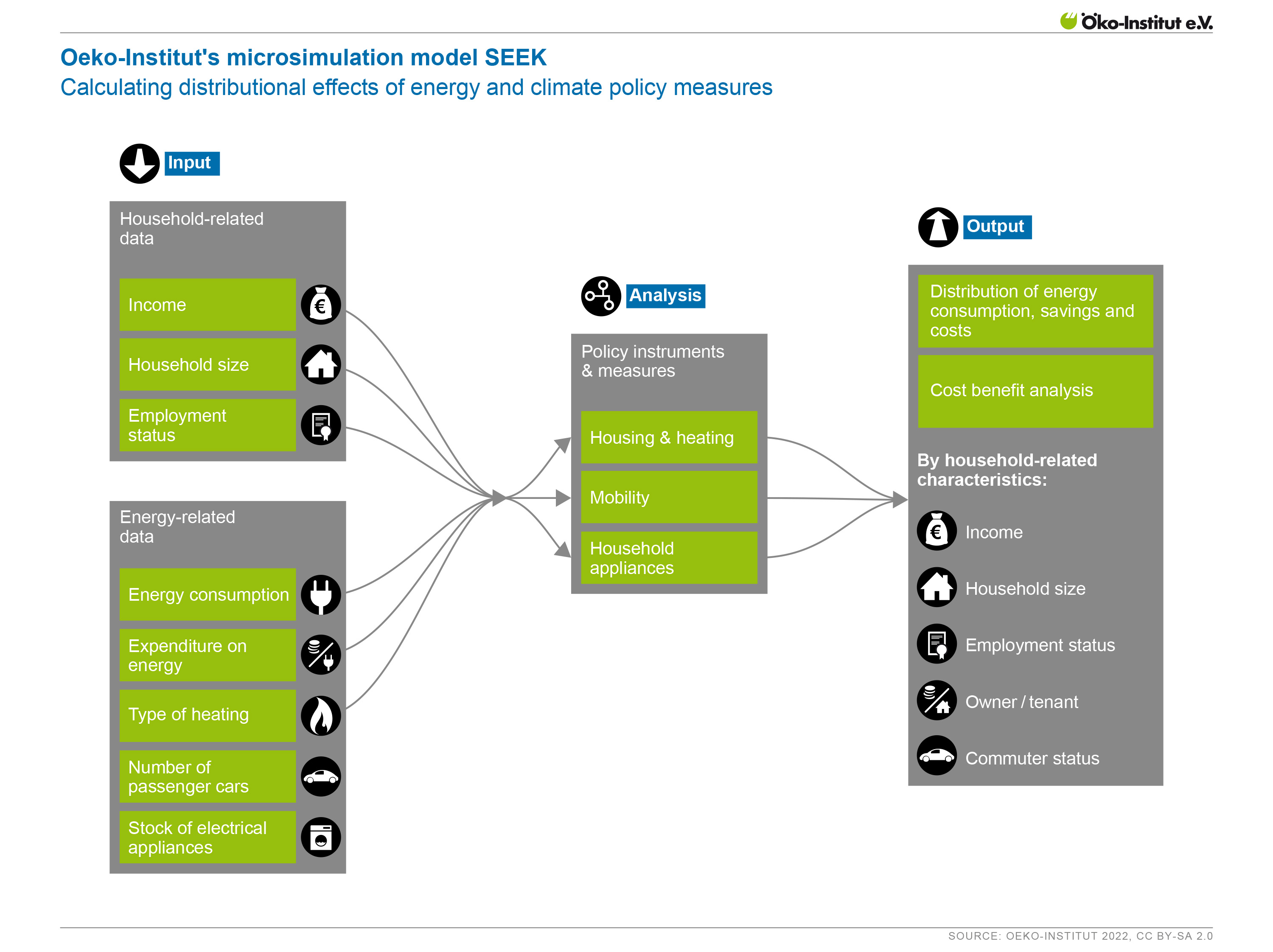
    Microsimulation model

    Model of distributional effects of energy and climate policy measures

    Image08/04/2022663.01 KB
    Microsimulation model
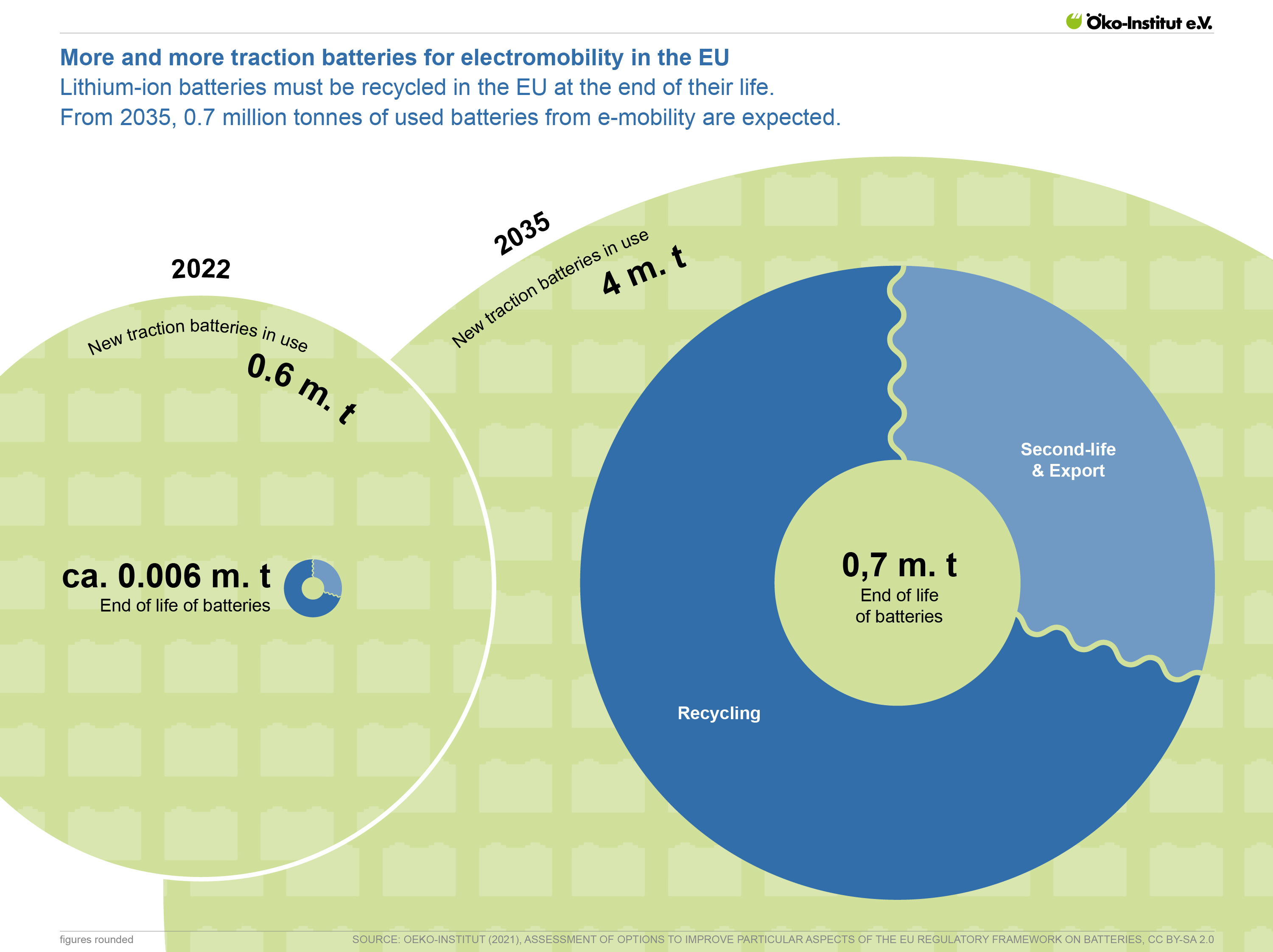
  • More and more traction batteries for electromobility in the EU

    In view of the currently rapidly growing number of used batteries from electric vehicles, buses and e-scooters, the question of proper end-of-life management is becoming more and more urgent (see infographic). Although recycling capacities are being built up in the EU, the logistics and recycling processes are usually associated with considerable costs.

    "There is currently a trend to 'donate' used batteries to other countries," says battery researcher Dr Johannes Betz of the Oeko-Institut. Many manufacturers argue that used batteries can still be used – for example in solar projects in Africa. More and more projects and press releases are praising this so-called repurposing approach as a solution. "Repurposing of used Li-ion batteries can certainly yield many environmental benefits”, says Betz. "But it is hard to understand why the focus is on shipping old batteries to low- and middle-income countries, given the great need for electricity storage in Germany and the EU”.

    More and more traction batteries for electromobility in the EU

    Image06/15/2022975.91 KB
    In view of the currently rapidly growing number of used batteries from electric vehicles, buses and e-scooters, the question of proper end-of-life management is becoming more and more urgent (see infographic). Although recycling capacities are being built up in the EU, the logistics and recycling processes are usually associated with considerable costs.
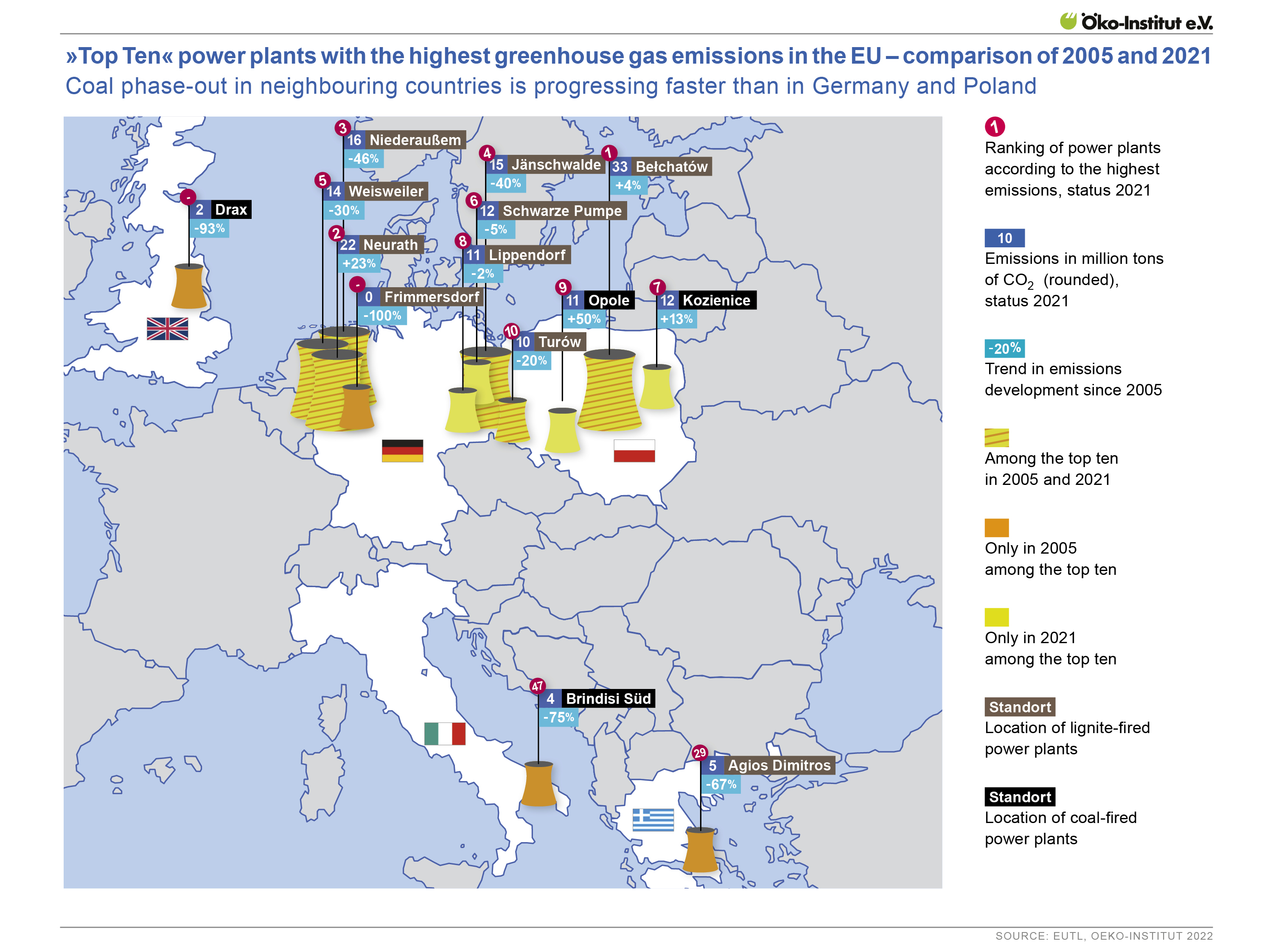
  • Top Ten« power plants with the highest greenhouse gas emissions in the EU – comparison of 2005 and 2021 - Coal phase-out in neighbouring countries is progressing faster than in Germany and Poland

    The map shows the ten coal-fired power plants in the European Union with the highest absolute CO2 emissions in 2021 compared to 2005.

    Top Ten« power plants with the highest greenhouse gas emissions in the EU – comparison of 2005 and 2021 - Coal phase-out in neighbouring countries is progressing faster than in Germany and Poland

    Image06/14/20221.80 MB
    The map shows the ten coal-fired power plants in the European Union with the highest absolute CO2 emissions in 2021 compared to 2005.
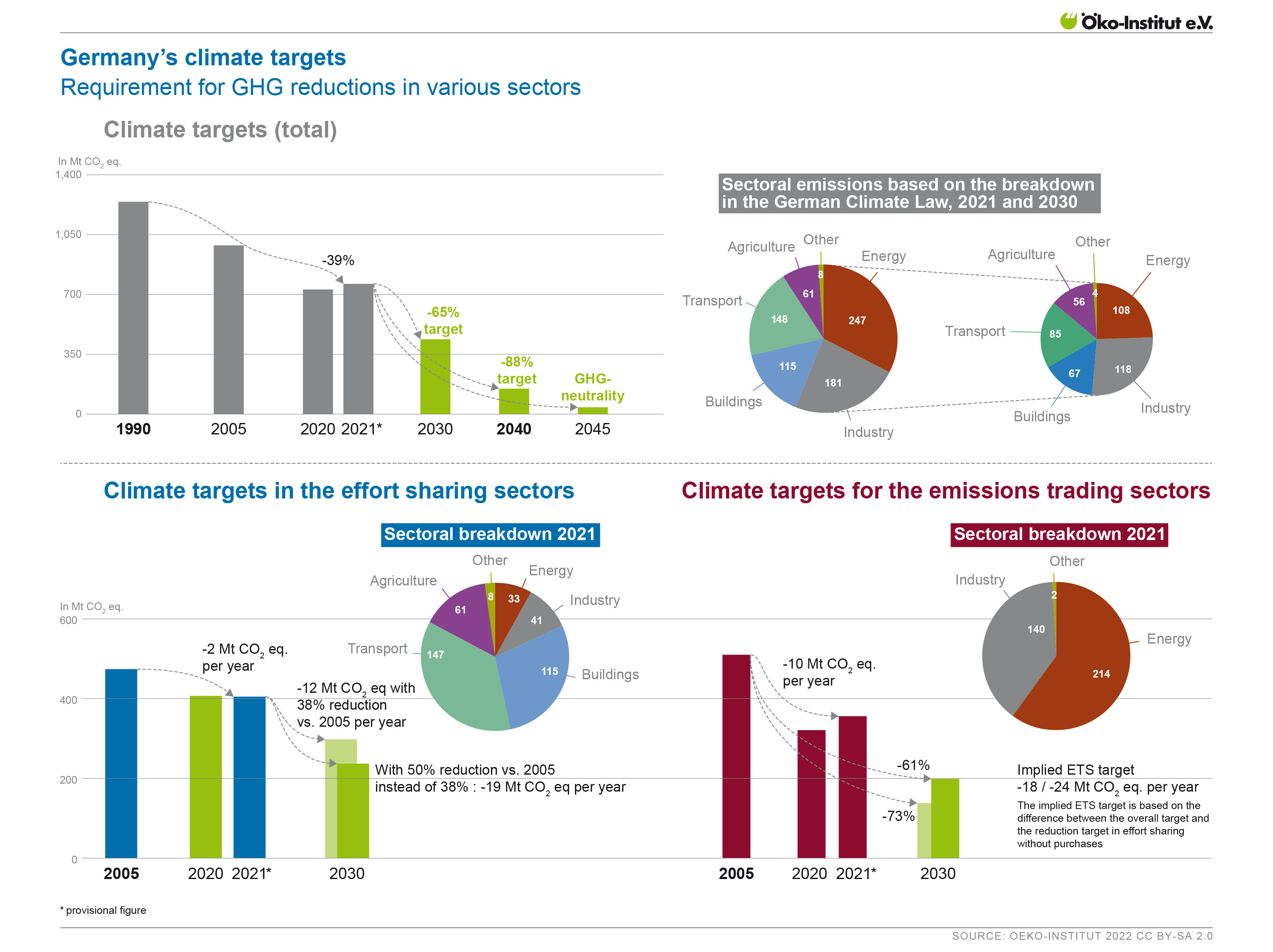
  • Germany's climate targets

    The diagrams show how greenhouse gas emissions in various sectors need to be reduced to meet the German government’s national targets and the targets imposed on Germany by the European Union’s climate regime.
    The chart top left depicts the fall in Germany’s greenhouse gas emissions that is required by the targets of Germany’s Climate Change Act of August 2021. The German government has set targets for 2030, 2040 and 2045.

    The chart top right shows how total emissions reductions are distributed between the various sectors of the economy – energy, industry, agriculture, transport, buildings and other (waste management). In the Climate Change Act the goal of a 65% reduction in emissions by 2030 is broken down into sectoral targets. The chart highlights the fact that emissions in all sectors must fall significantly between 2021 and 2030 if the sectoral targets – and hence the overall target – are to be met.

    The two lower diagrams depict the German targets that arise directly or indirectly from European climate policy instruments. For all European countries, the Effort Sharing Regulation sets reduction targets for emissions from transport, agriculture, buildings and waste and for industrial facilities and energy plants that are not covered by the European Emissions Trading System. The diagram on the left shows the historical emissions for 2005, 2020 and 2021 (provisional), the targets for 2030 and the distribution of all 2021 emissions between sectors. The sectoral breakdown of effort sharing and emissions trading emissions is based on the system used in the Oeko-Institut’s assessment of the environmental, social and economic impacts of the sectoral targets for 2030 contained in the German government’s Climate Action Plan 2050 (Folgenabschätzung zu den ökologischen, sozialen und wirtschaftlichen Folgewirkungen der Sektorziele für 2030 des Klimaschutzplans 2050 der Bundesregierung, Öko-institut et al. 2019). Between 2005 and 2021, effort sharing emissions fell by 2 Mt CO2 eq. per year. The existing target for Germany requires a 38% reduction from the 2005 baseline (EU Regulation 2018/842). To meet this target by 2030 without having to buy any AEA (Annual Emission Allocations), effort sharing emissions would have to fall by 12 Mt CO2 eq. per year. The tightening of the European climate target to 55% against a 1990 baseline means that national targets also need to be revised. For Germany the European Commission’s proposal (COM(2021) 555) sets out a reduction target of 50% by comparison with 2005. To meet this target, emissions in this area would have to fall by 19 Mt CO2 eq. per year.

    The Emissions Trading System regulates emissions cuts in industry and the energy sector at European level. In the emissions trading sectors Germany has in the past achieved reductions of 10 Mt CO2 eq. per year – significantly larger cuts than in the effort sharing sector. The diagram bottom right shows historical emissions in the emissions trading sectors in 2005 and 2021 and the distribution of emissions between the sectors in 2021. From the target of a 65% reduction in total greenhouse gas emissions by 2030 and the absolute reduction targets in the effort sharing areas it is possible to cal-culate implied reduction targets for the emissions trading sectors. The implied target is the proportion of the reduction that must be borne by industry and the energy sector if the national emissions target is to be met – if the effort sharing target is achieved without purchases. This implied target requires cuts of 24 Mt CO2 eq. per year (energy) and 18 Mt CO2 eq. per year (industry) in the emissions trading sectors. The European Commission’s proposal assumes equivalent reduction efforts in the two sectors. Germany’s emissions reductions in the EU-ETS would then amount to 61% by comparison with 2005, which roughly corresponds to the European target in this area.

    Germany's climate targets

    Image05/16/2022788.40 KB
    The diagrams show how greenhouse gas emissions in various sectors need to be reduced to meet the German government’s national targets and the targets imposed on Germany by the European Union’s climate regime.
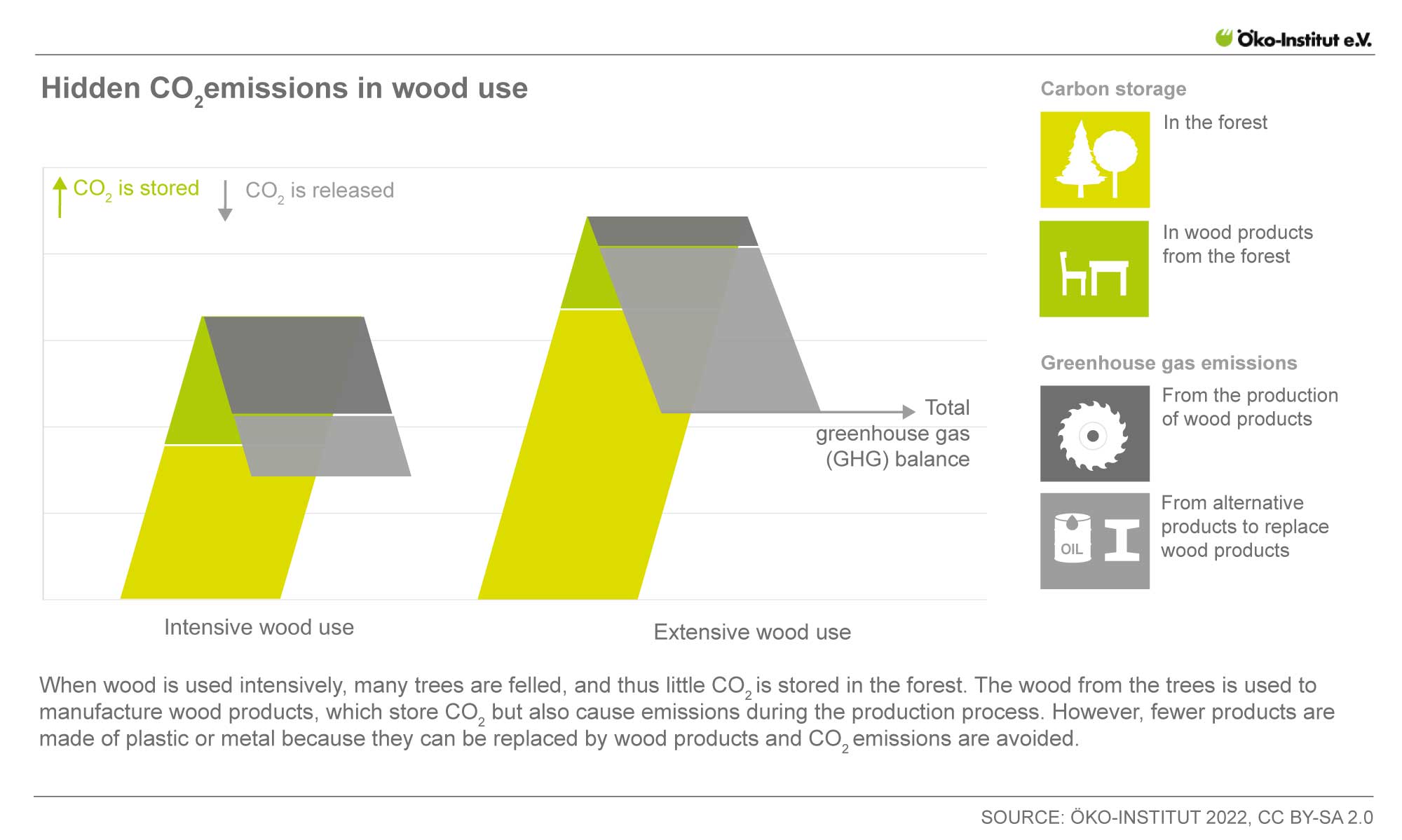
  • Hidden carbon emissions from wood use

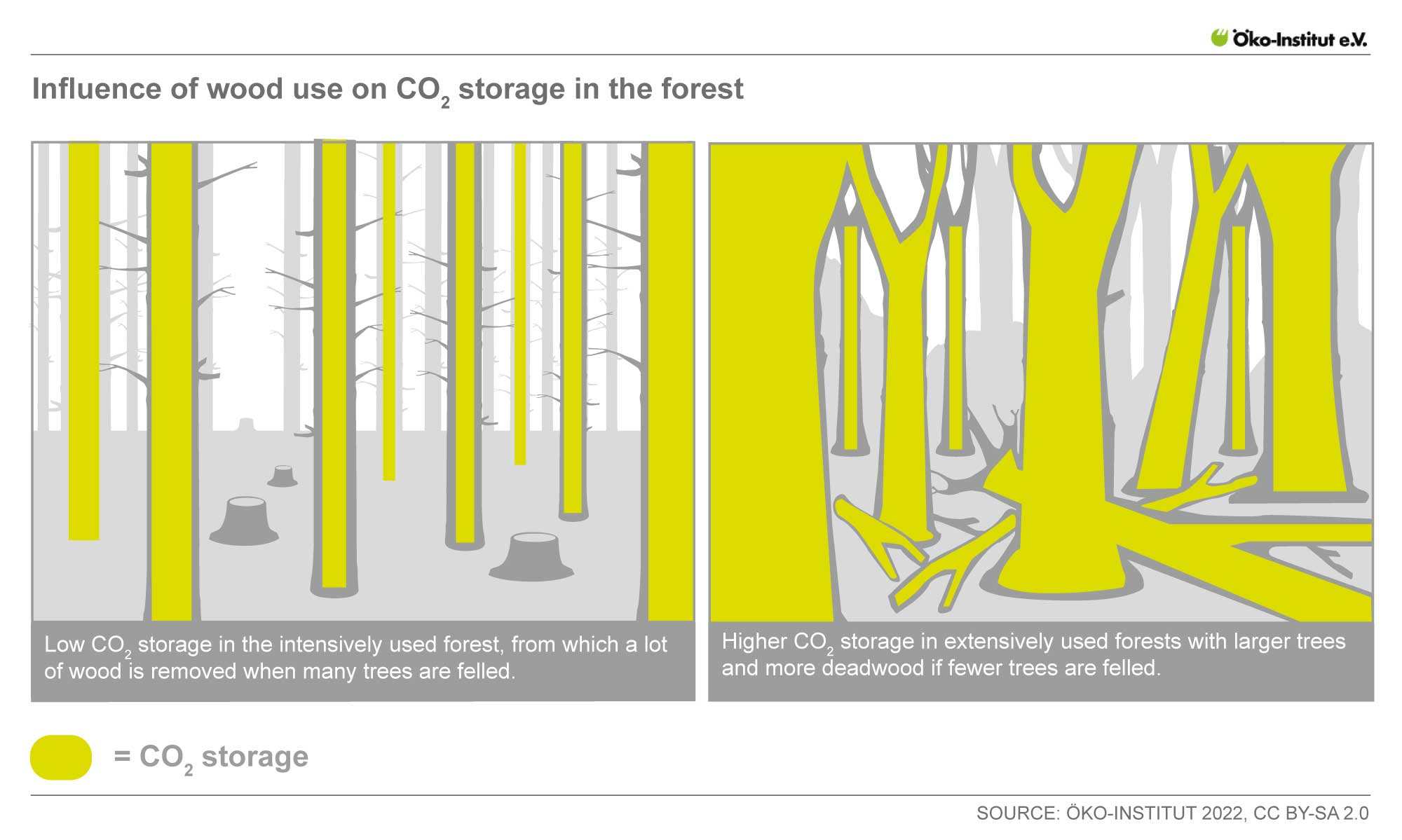
    Forests play an important role on the path to carbon neutrality by 2045. On the one hand, they provide wood, a replenishable raw material, which can be used to substitute carbon-intensive materials such as steel and concrete as well as energy sources such as coal or natural gas. At the same time, however, forests themselves can be carbon stores and help to reduce the concentration of greenhouse gases in the atmosphere. This carbon sink capacity of the forest increases at the landscape level the less intensively forests are used, i.e. first and foremost the less wood is harvested. When considering the question as to whether the harvesting and use of wood results in an overall reduction in atmospheric greenhouse gas concentrations, these effects must be taken into account. The infographic shows the differences in sink capacities between intensive and extensive wood use.
    For more information please refer to the Oeko-Institut website on "CO₂ Storage Balance - Making CO₂ emissions from wood use visible" https://co2-speichersaldo.de/en/index.html

    Hidden carbon emissions from wood use

    Image04/27/2022100.23 KB
    Forests play an important role on the path to carbon neutrality by 2045. On the one hand, they provide wood, a replenishable raw material, which can be used to substitute carbon-intensive materials such as steel and concrete as well as energy sources such as coal or natural gas. At the same time, however, forests themselves can be carbon stores and help to reduce the concentration of greenhouse gases in the atmosphere.
  • Impact of wood use on forest carbon pools

    As growing carbon pools, forests can help to reduce the concentration of greenhouse gases in the atmosphere. This carbon storage – also termed carbon sink capacity – strongly depends on the intensity of forest management and timber extraction. The infographic shows the impact of intensive and extensive wood use on the forest carbon pool. If more intensive wood use takes place in the forest, i.e. trees are felled and extracted, the forest’s carbon pool is reduced. At the same time, there are fewer living trees that can continue to absorb CO₂, so the carbon storage capacity decreases. If, in contrast, the forest is used less intensively, the carbon storage capacity increases because more stored carbon remains in the forest in the form of biomass and a greater amount of carbon is newly stored.
    To measure the potential storage capacity of a forest, the Oeko-Institut developed a carbon storage balance calculation method. The carbon storage balance indicates the change in the carbon storage capacity of the forest in response to the removal of one cubic metre of wood. It is expressed in tonnes of CO₂ per cubic metre of wood removed (for example 0.6 t CO₂/m³).
    For more information please refer to the Oeko-Institut website on "CO₂ Storage Balance - Making CO₂ emissions from wood use visible": https://co2-speichersaldo.de/en/index.html

    Impact of wood use on forest carbon pools

    Image04/27/2022121.18 KB
    As growing carbon pools, forests can help to reduce the concentration of greenhouse gases in the atmosphere. This carbon storage – also termed carbon sink capacity – strongly depends on the intensity of forest management and timber extraction.
  • Nature-based Solutions

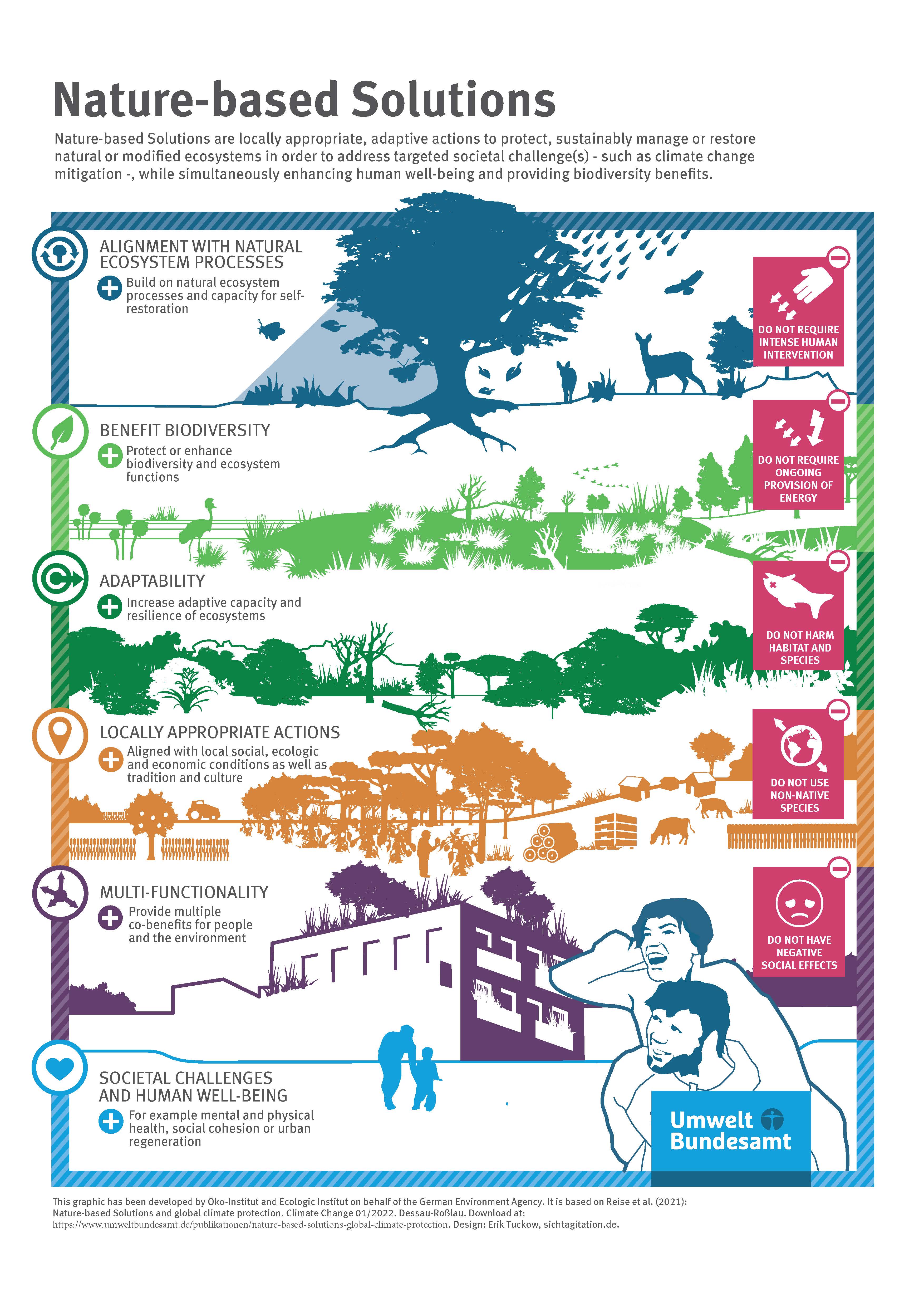
    Nature-based Solutions are locally appropriate, adaptive actions to protect, sustainably manage or restore natural or modified ecosystems in order to address targeted societal challenge(s) - such as climate change mitigation -, while simultaneously enhancing human well-being and providing biodiversity benefits.

    More details about nature-based solutions in the study for the UBA: https://www.oeko.de/en/up-to-date/2022/die-rolle-von-naturbasierten-loesungen-im-globalen-klimaschutz

    Nature-based Solutions

    Image01/21/20221.17 MB
    Nature-based Solutions are locally appropriate, adaptive actions to protect, sustainably manage or restore natural or modified ecosystems in order to address targeted societal challenge(s) - such as climate change mitigation -, while simultaneously enhancing human well-being and providing biodiversity benefits.
  • Farming’s contributions to climate action

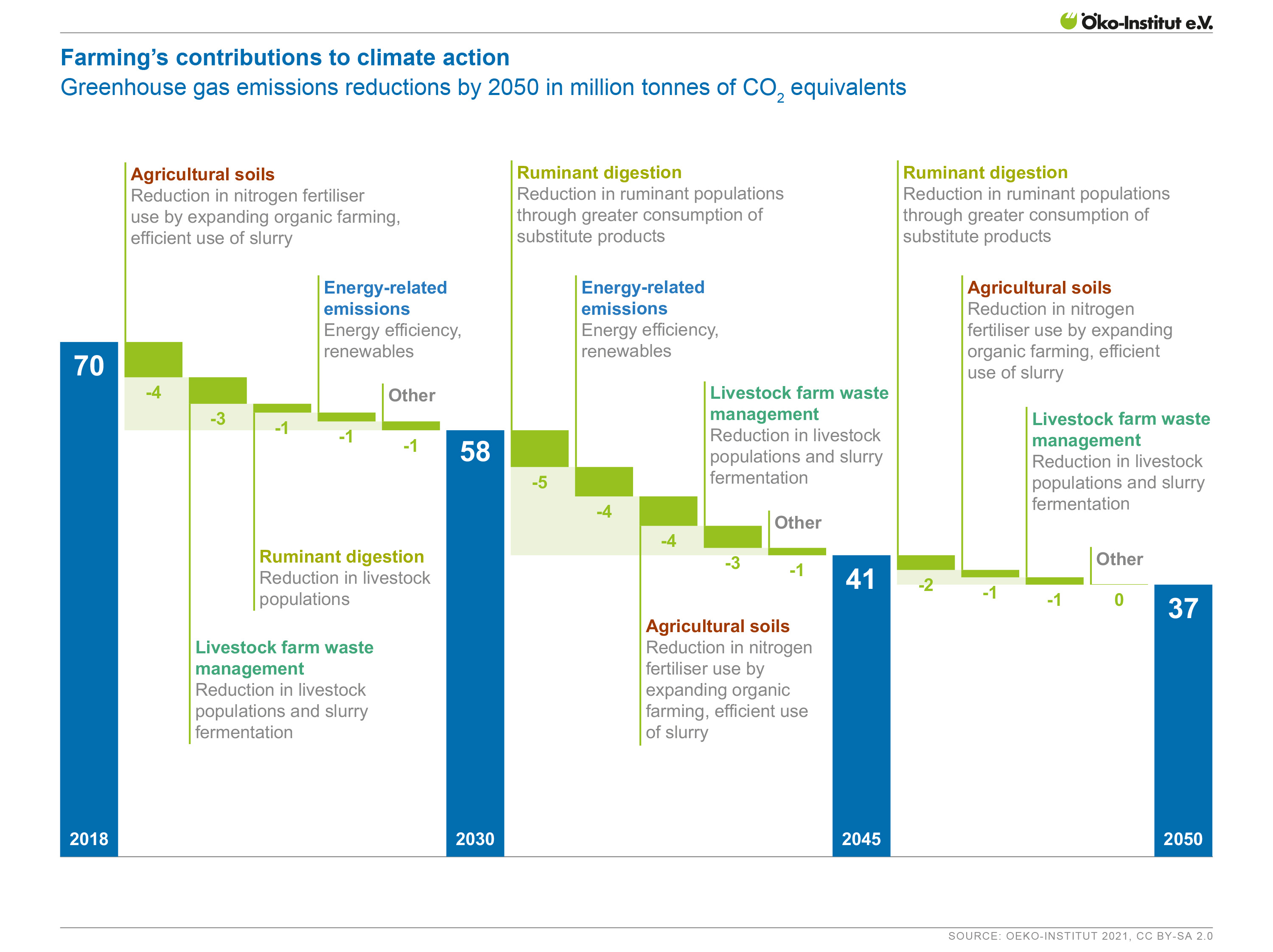
    The infographic shows the potential for reducing climate-damaging greenhouse gases in agriculture. In this way, emissions can be completely reduced to zero by the year 2045 or 2050.

    Further information in the study "Klimaneutrales Deutschland 2045. Wie Deutschland seine Klimaziele schon vor 2050 erreichen kann" ("Climate-neutral Germany 2045. How Germany can achieve its climate goals even before 2050") by Oeko-Institut, Prognos and Wuppertal Institute: https://www.oeko.de/aktuelles/2021/wie-deutschland-bis-2045-klimaneutral-wird

    Farming’s contributions to climate action

    Image07/09/2021785.05 KB
    The infographic shows the potential for reducing climate-damaging greenhouse gases in agriculture. In this way, emissions can be completely reduced to zero by the year 2045 or 2050.
  • NDC Design

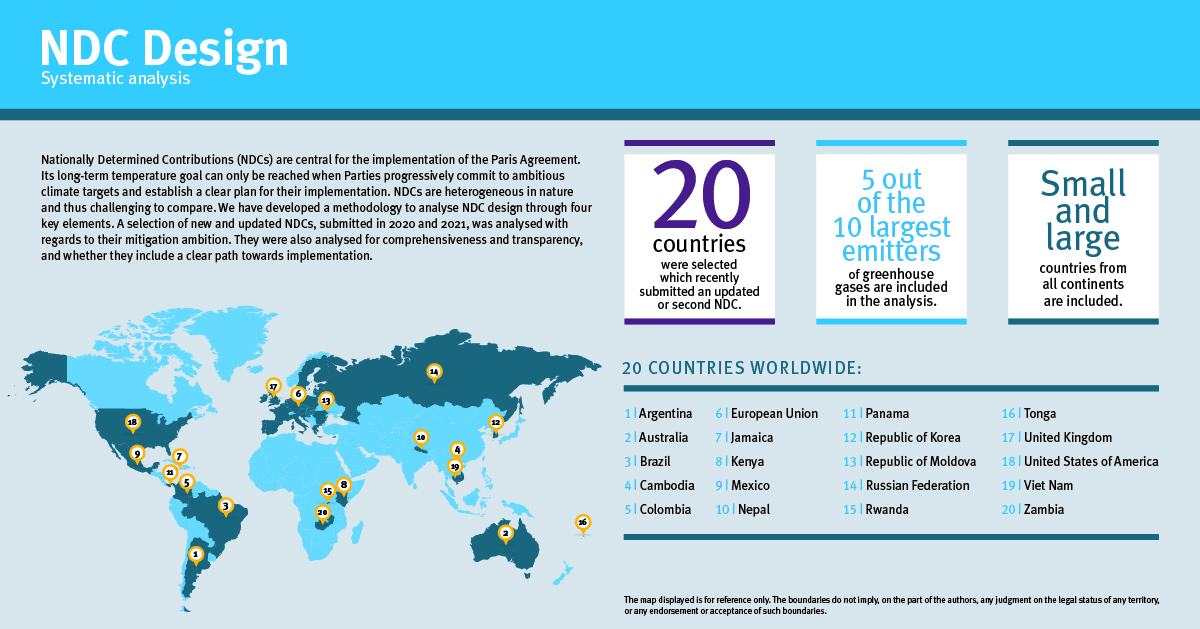
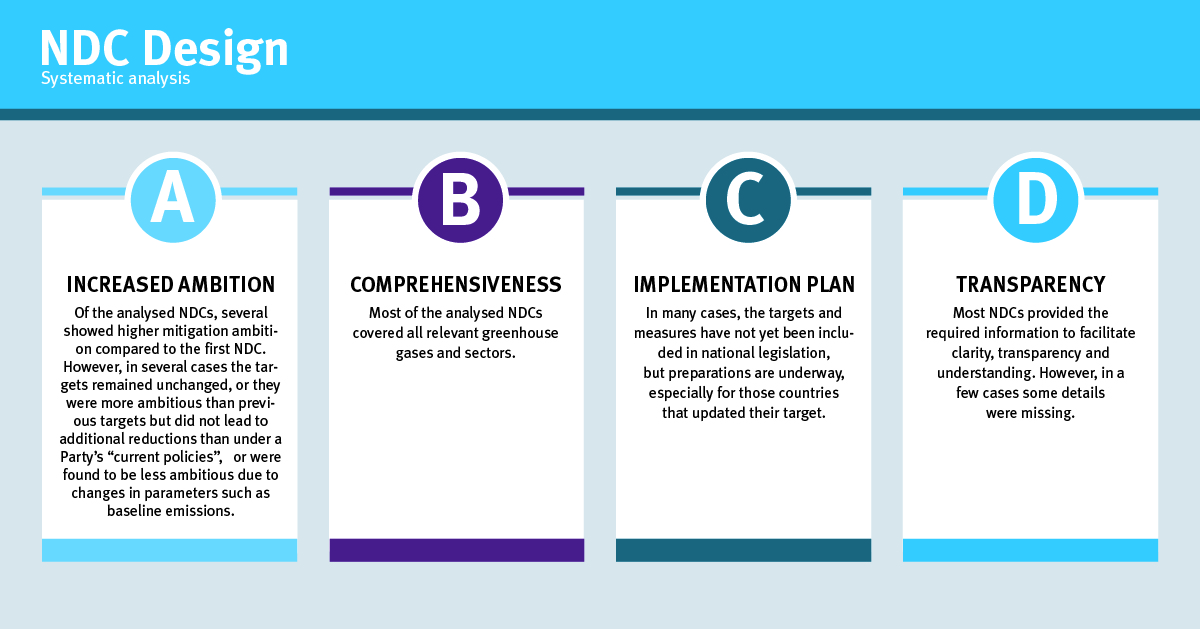
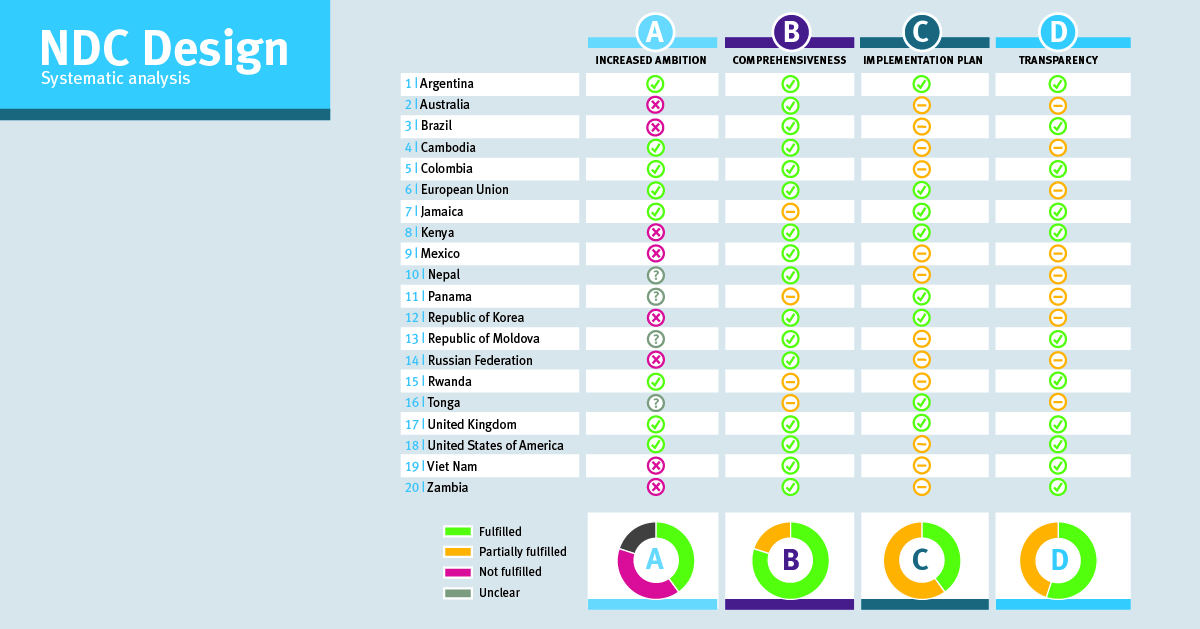
    Nationally Determined Contributions (NDCs) are central for the implementation of the Paris Agreement. Its long-term temperature goal can only be reached when Parties progressively commit to ambitious climate targets and establish a clear plan for their implementation. NDCs are heterogeneous in nature and thus challenging to compare. The infographic shows the results of a method development by the NewClimate Institute and Oeko-Institut for the Federal Environment Agency (Umweltbundesamt) to analyse NDC design through four key elements. A selection of new and updated NDCs, submitted in 2020 and 2021, was analysed with regards to their mitigation ambition. They were also analysed for comprehensiveness and transparency, and whether they include a clear path towards implementation.

    See study „NDC Design – Systematic analysis“ https://www.oeko.de/publikationen/p-details/ndc-design

    NDC Design

    Image07/09/20211.12 MB
    Nationally Determined Contributions (NDCs) are central for the implementation of the Paris Agreement. Its long-term temperature goal can only be reached when Parties progressively commit to ambitious climate targets and establish a clear plan for their implementation. NDCs are heterogeneous in nature and thus challenging to compare. The infographic shows the results of a method development by the NewClimate Institute and Oeko-Institut for the Federal Environment Agency (Umweltbundesamt) to analyse NDC design through four key elements.
  • NDC Design – Systematic analysis

    Nationally Determined Contributions (NDCs) are central for the implementation of the Paris Agreement. Its long-term temperature goal can only be reached when Parties progressively commit to ambitious climate targets and establish a clear plan for their implementation. NDCs are heterogeneous in nature and thus challenging to compare. The infographic shows the results of a method development by the NewClimate Institute and Oeko-Institut for the Federal Environment Agency (Umweltbundesamt) to analyse NDC design through four key elements. A selection of new and updated NDCs, submitted in 2020 and 2021, was analysed with regards to their mitigation ambition. They were also analysed for comprehensiveness and transparency, and whether they include a clear path towards implementation.

    See study „NDC Design – Systematic analysis“ https://www.oeko.de/publikationen/p-details/ndc-design

    NDC Design – Systematic analysis

    Image07/09/2021879.19 KB
    Nationally Determined Contributions (NDCs) are central for the implementation of the Paris Agreement. Its long-term temperature goal can only be reached when Parties progressively commit to ambitious climate targets and establish a clear plan for their implementation. NDCs are heterogeneous in nature and thus challenging to compare. The infographic shows the results of a method development by the NewClimate Institute and Oeko-Institut for the Federal Environment Agency (Umweltbundesamt) to analyse NDC design through four key elements.
  • NDC Design – Systematic analysis

    Nationally Determined Contributions (NDCs) are central for the implementation of the Paris Agreement. Its long-term temperature goal can only be reached when Parties progressively commit to ambitious climate targets and establish a clear plan for their implementation. NDCs are heterogeneous in nature and thus challenging to compare. The infographic shows the results of a method development by the NewClimate Institute and Oeko-Institut for the Federal Environment Agency (Umweltbundesamt) to analyse NDC design through four key elements. A selection of new and updated NDCs, submitted in 2020 and 2021, was analysed with regards to their mitigation ambition. They were also analysed for comprehensiveness and transparency, and whether they include a clear path towards implementation.

    See study „NDC Design – Systematic analysis“ https://www.oeko.de/publikationen/p-details/ndc-design

    NDC Design – Systematic analysis

    Image07/09/20211.12 MB
    Nationally Determined Contributions (NDCs) are central for the implementation of the Paris Agreement. Its long-term temperature goal can only be reached when Parties progressively commit to ambitious climate targets and establish a clear plan for their implementation. NDCs are heterogeneous in nature and thus challenging to compare. The infographic shows the results of a method development by the NewClimate Institute and Oeko-Institut for the Federal Environment Agency (Umweltbundesamt) to analyse NDC design through four key elements.
  • Climate-friendly mobility in urban and rural areas is possible

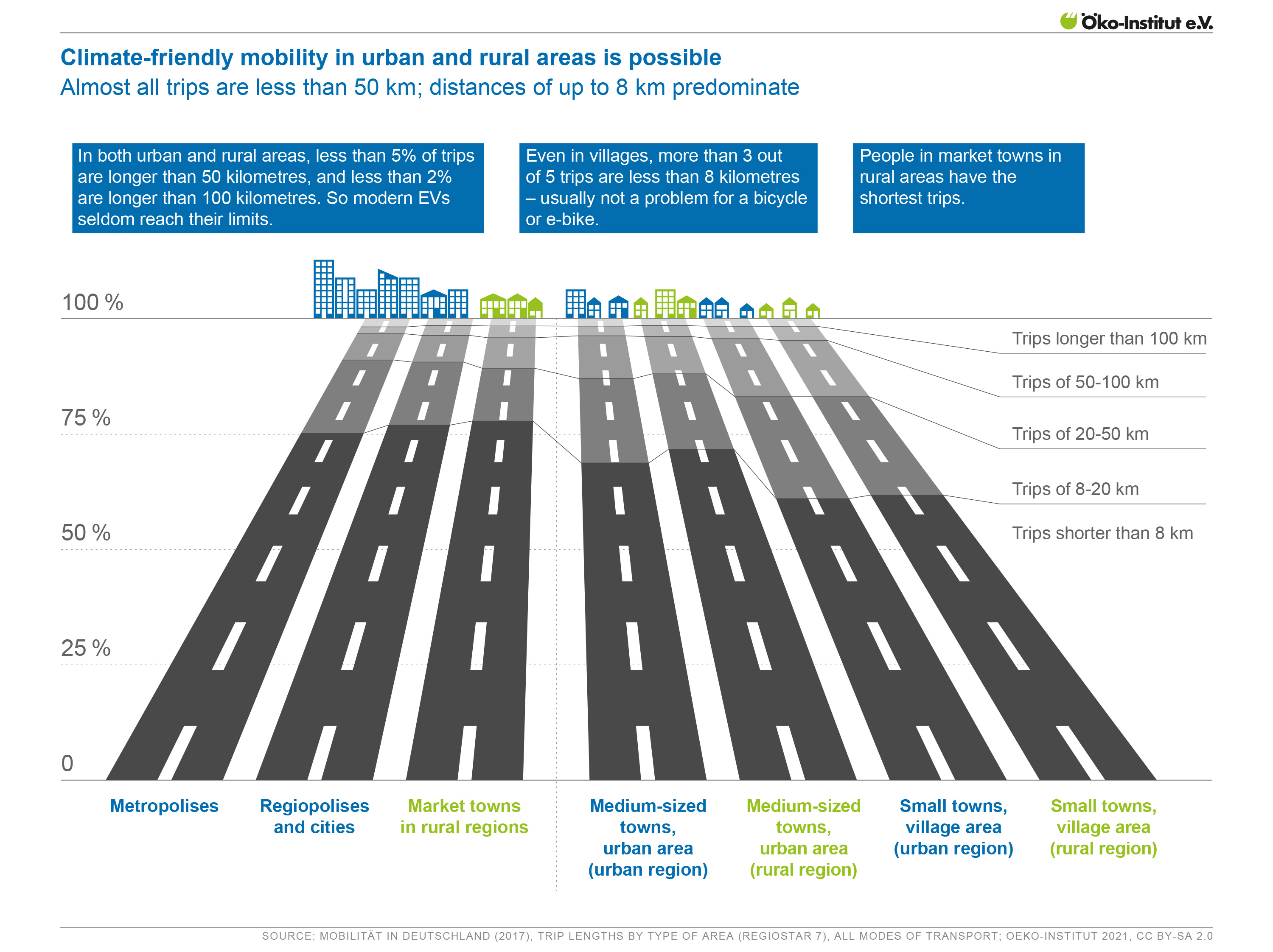
    Even in small towns and villages, a large proportion of the population can cover 60 per cent of their journeys without their own car because the distances are less than eight kilometres. Pedelecs offer additional possibilities, especially when the distances are longer than five kilometres, differences in altitude have to be overcome or loads have to be transported. Whether urban or rural, less than five percent of paths are longer than 50 kilometres and less than two percent are longer than 100 kilometres. Even the routes in this longest category can usually be completed without problems with today's electric vehicles, especially if reliable charging infrastructure is available at the destination or en route.

    Climate-friendly mobility in urban and rural areas is possible

    Image06/07/2021859.30 KB
    Even in small towns and villages, a large proportion of the population can cover 60 per cent of their journeys without their own car because the distances are less than eight kilometres.
  • Electric cars with cost advantage

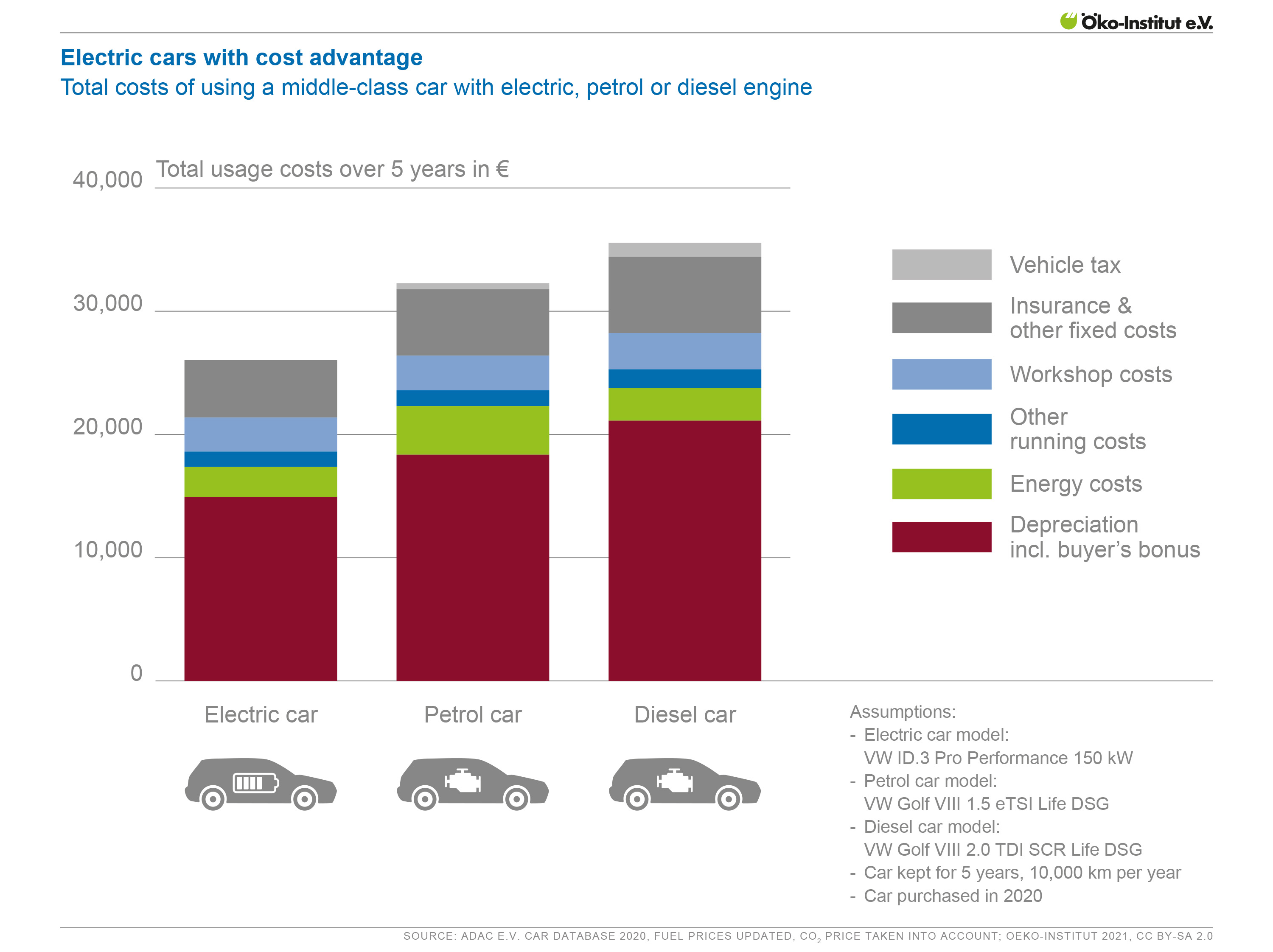
    Electric cars are cheaper than their reputation. In the calculation model, the experts calculated and compared the total costs of three mid-range cars with electric drive, petrol and diesel engines. The result: the electric car is the cheapest of all three in the purchase year 2020. The scientists took into account the purchase premium, the energy costs including the CO2 prices for petrol and diesel from 2021, the insurance and vehicle tax, workshop costs and the expected depreciation.

    Electric cars with cost advantage

    Image06/07/2021444.19 KB
    Electric cars are cheaper than their reputation. In the calculation model, the experts calculated and compared the total costs of three mid-range cars with electric drive, petrol and diesel engines.
  • Flying and climate protection: aviation's vision of the future

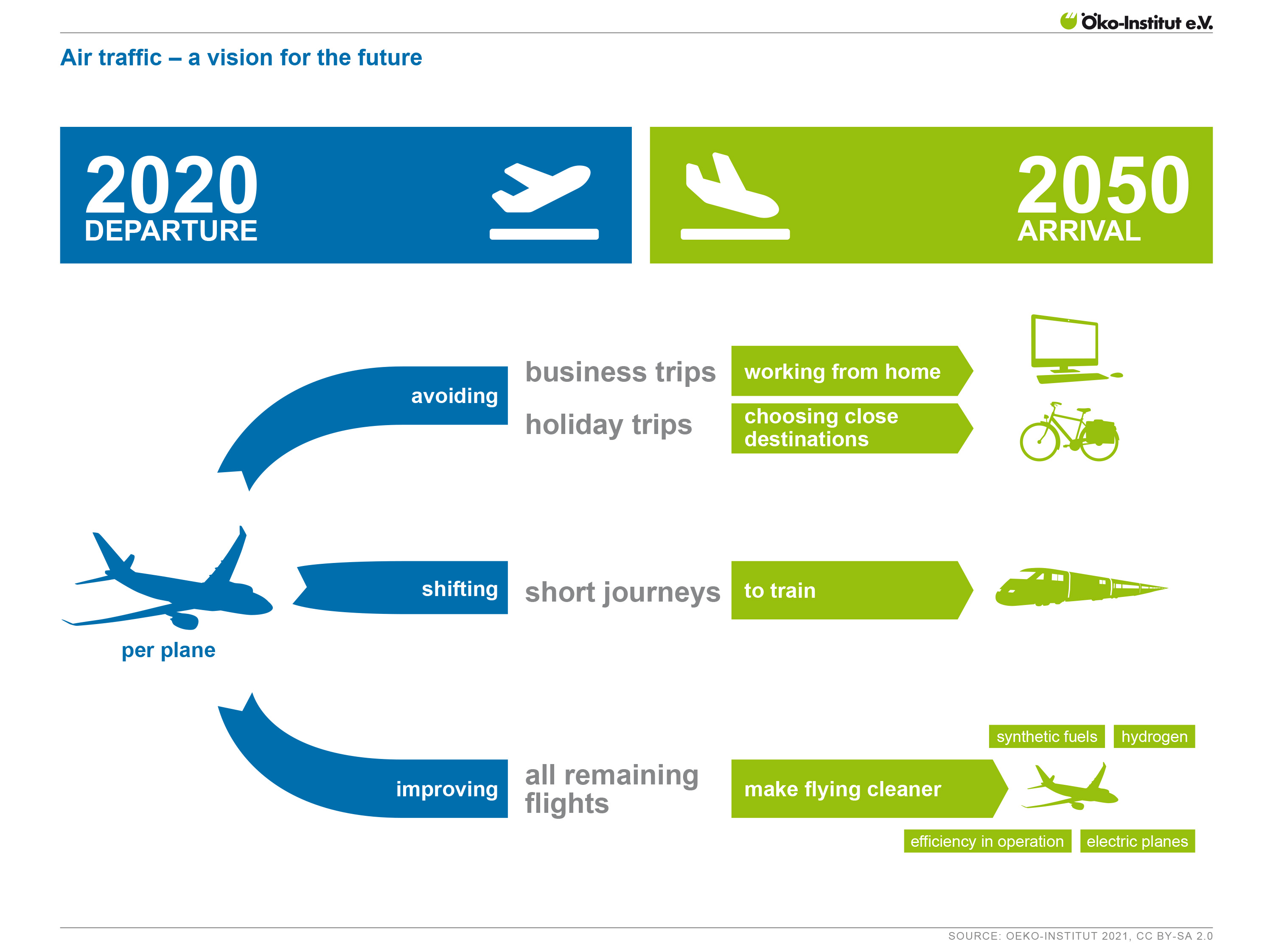
    If we want to limit global warming to 1.5°C, CO₂ emissions from aviation must also be reduced to zero. The infographic shows various options for action: The simplest and most effective way for climate protection in aviation is, of course, to avoid flights. Video conferencing and home office instead of business trips is one option. But the frequency of private long-distance travel must also be questioned: Taking the train instead of short-haul flights is a good way to shift air travel to earthbound mobility. In addition, new technologies will also be needed to strongly reduce the climate impact of flights - such as the use of hydrogen or synthetic kerosene.

    Further information: http://www.fliegen-und-klima.de/en

    Flying and climate protection: aviation's vision of the future

    Image06/01/2021607.35 KB
    If we want to limit global warming to 1.5°C, CO₂ emissions from aviation must also be reduced to zero. The infographic shows various options for action: The simplest and most effective way for climate protection in aviation is, of course, to avoid flights. Video conferencing and home office instead of business trips is one option.
  • Flying and climate protection: How greenhouse gas emissions from aviation can be reduced

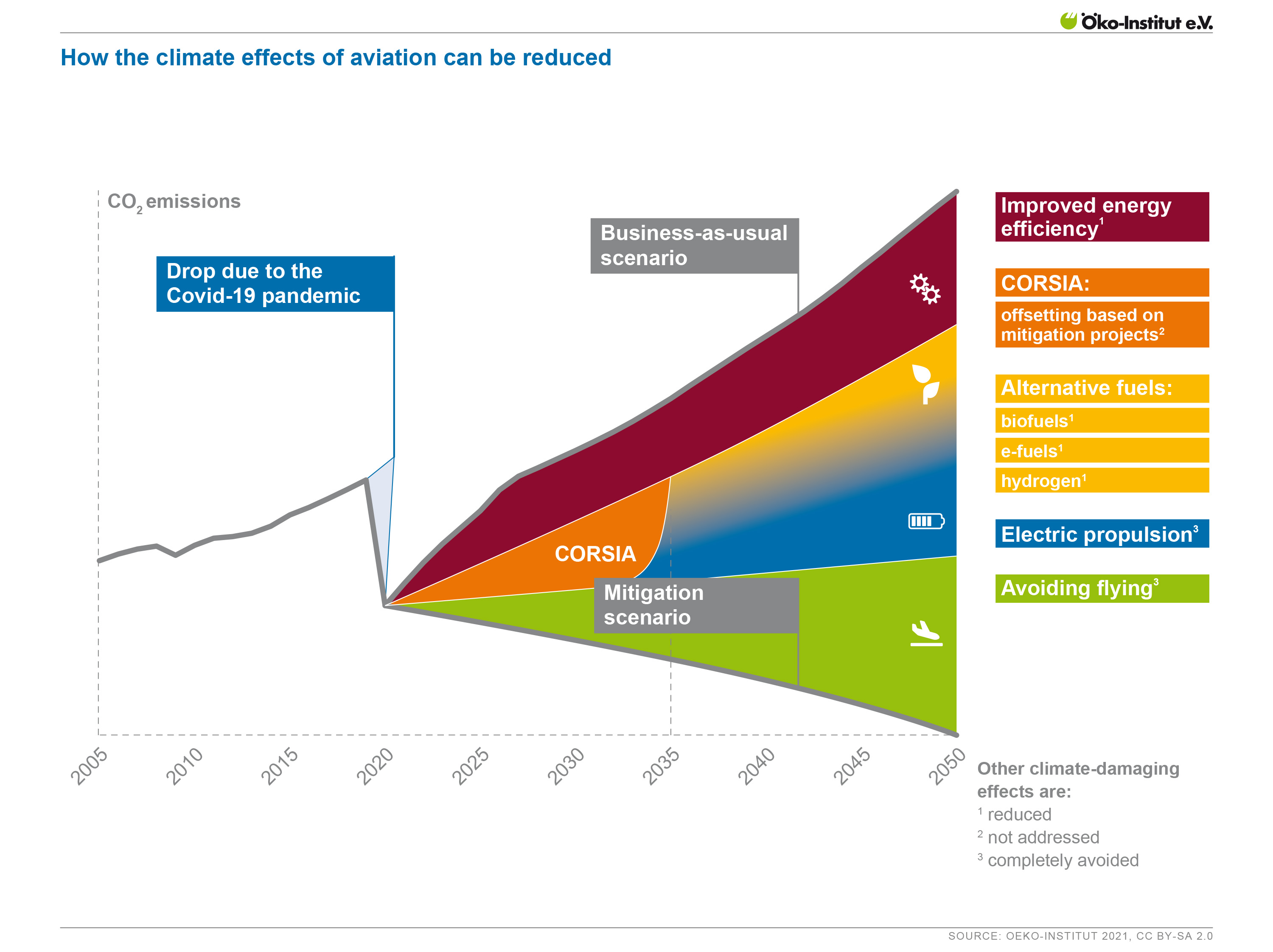
    Flying will not be completely avoidable in the future. Therefore, various measures can be taken to mitigate emissions and reduce the harmful impact on the climate. There are two main ways to do this in the long term: using alternative fuels - such as E-Fuels or sustainable biofuels - and alternative propulsion concepts such as hydrogen and electric aircraft.

    The infographic shows the potential of the various measures to reduce climate-damaging greenhouse gas emissions from aviation. Taken together, they can reduce emissions to zero by 2050.

    Further information: http://www.fliegen-und-klima.de/en

    Flying and climate protection: How greenhouse gas emissions from aviation can be reduced

    Image06/01/2021659.71 KB
    Flying will not be completely avoidable in the future. Therefore, various measures can be taken to mitigate emissions and reduce the harmful impact on the climate. There are two main ways to do this in the long term: using alternative fuels - such as E-Fuels or sustainable biofuels - and alternative propulsion concepts such as hydrogen and electric aircraft.
  • Flying and climate protection: How greenhouse gas emissions have developed in the EU

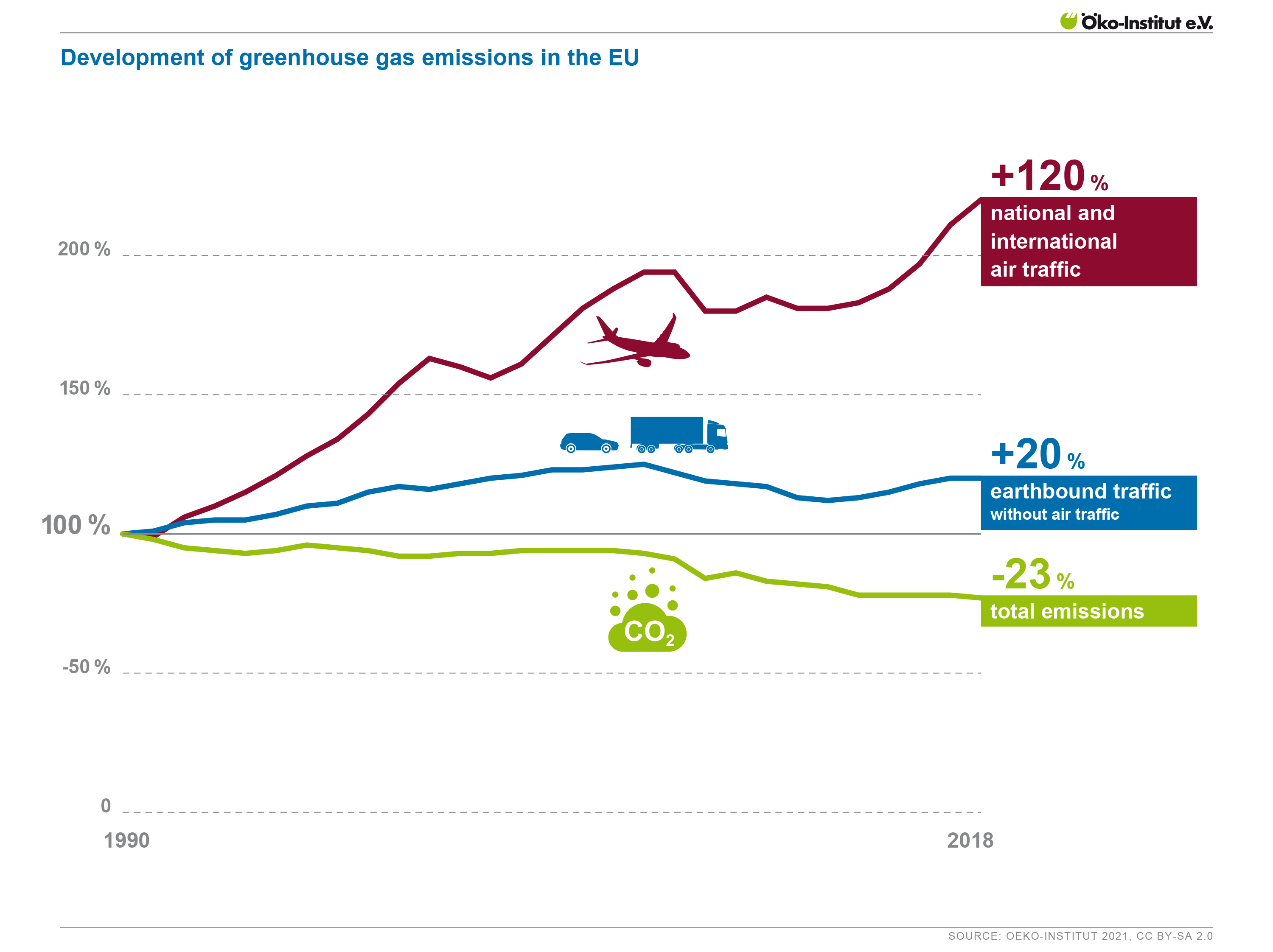
    Flying is the most climate-damaging form of mobility: on the one hand, the combustion of fossil kerosene generates CO2 emissions; on the other hand, it contributes to climate heating through nitrogen oxides, contrails and changes in cloud cover. For example, international air travel from Germany caused a total of 29.4 million metric tons of CO2 emissions in 2018. That's about 3.4 percent of Germany's total emissions in that year and about as much as Los Angeles, with a population of nearly four million people, emits annually. BUT: Overall, the total climate impact of aviation is estimated to be about three times that of CO₂ emissions alone if aviation continues to grow at the same rate in the future as it did before the Covid-19 pandemic.

    The infographic shows the progression of greenhouse gas emissions since 1990 for aviation as well as earthbound transport and total emissions in the EU.

    Further information: http://www.fliegen-und-klima.de/en

    Flying and climate protection: How greenhouse gas emissions have developed in the EU

    Image06/01/2021532.50 KB
    Flying is the most climate-damaging form of mobility: on the one hand, the combustion of fossil kerosene generates CO2 emissions; on the other hand, it contributes to climate heating through nitrogen oxides, contrails and changes in cloud cover.
  • Flying and climate protection: Offsetting versus climate responsibility

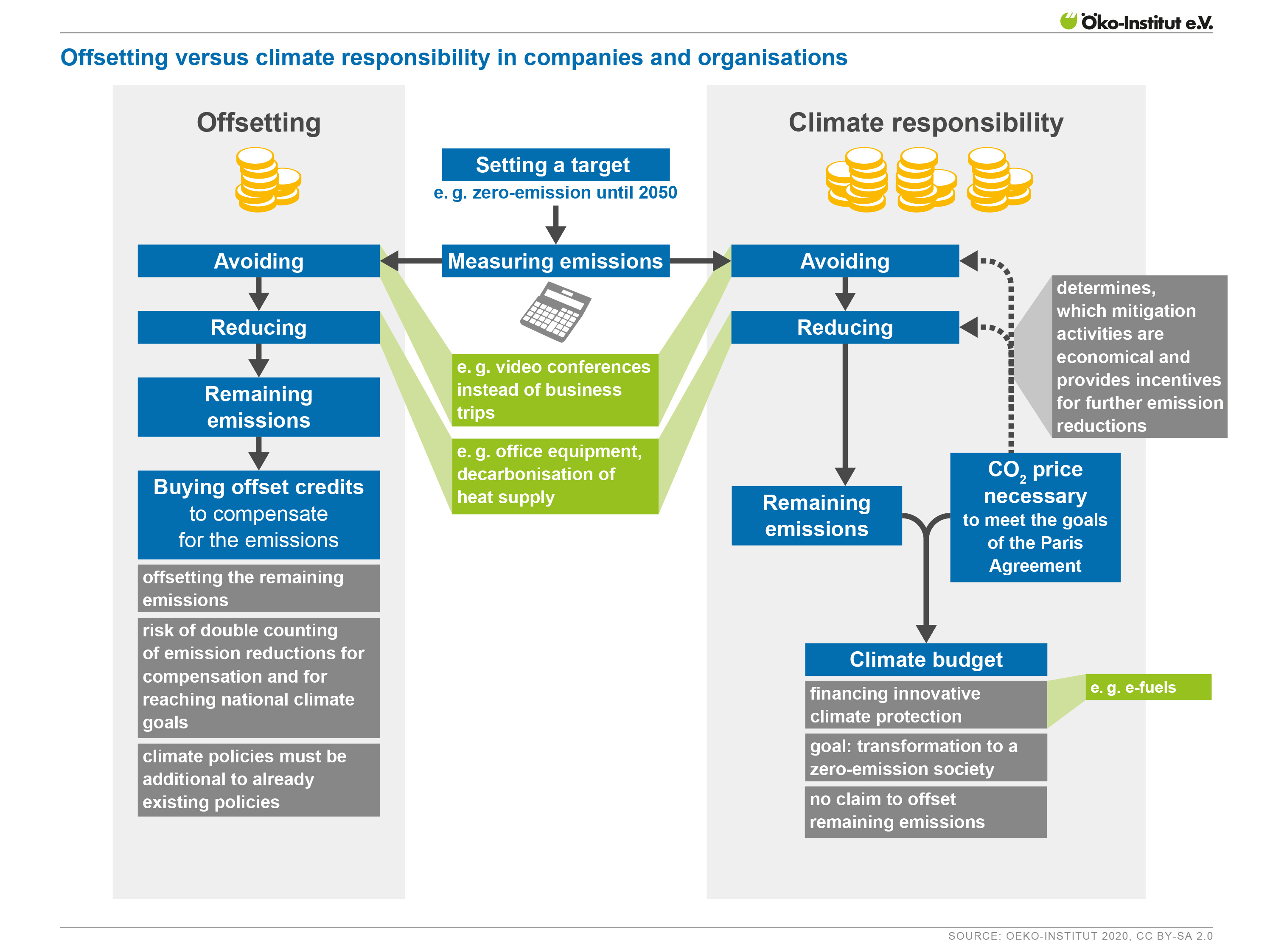
    More and more airlines and travelers are relying on offsetting the climate impact of their flights. With offsetting - or carbon offsetting - the climate impact of flights is compensated by greenhouse gas reduction measures from other actors, such as renewable energy.

    The infographic shows the differences between the two concepts of "climate offsetting" and "climate responsibility." As a general rule, offsetting or the financing of innovative climate protection should always be the last step towards more climate protection in air transport - the priority should always be to avoid flights wherever possible.

    In contrast to climate offsetting, which compensates for the emissions caused, the concept of climate responsibility provides a budget that is used to finance climate protection innovations, breakthrough technologies and the transformation to a zero-emissions society. Unlike offsetting, this climate responsibility budget is not based on the current prices for offset certificates, but on a significantly higher CO₂ price. The higher CO₂ price also makes own mitigation options more attractive, which in turn contribute to emissions reduction.

    Further information: http://www.fliegen-und-klima.de/en

    Flying and climate protection: Offsetting versus climate responsibility

    Image06/01/2021898.78 KB
    More and more airlines and travelers are relying on offsetting the climate impact of their flights. With offsetting - or carbon offsetting - the climate impact of flights is compensated by greenhouse gas reduction measures from other actors, such as renewable energy. The infographic shows the differences between the two concepts of "climate offsetting" and "climate responsibility." As a general rule, offsetting or the financing of innovative climate protection should always be the last step towards more climate protection in air transport - the priority should always be to avoid flights wherever possible.
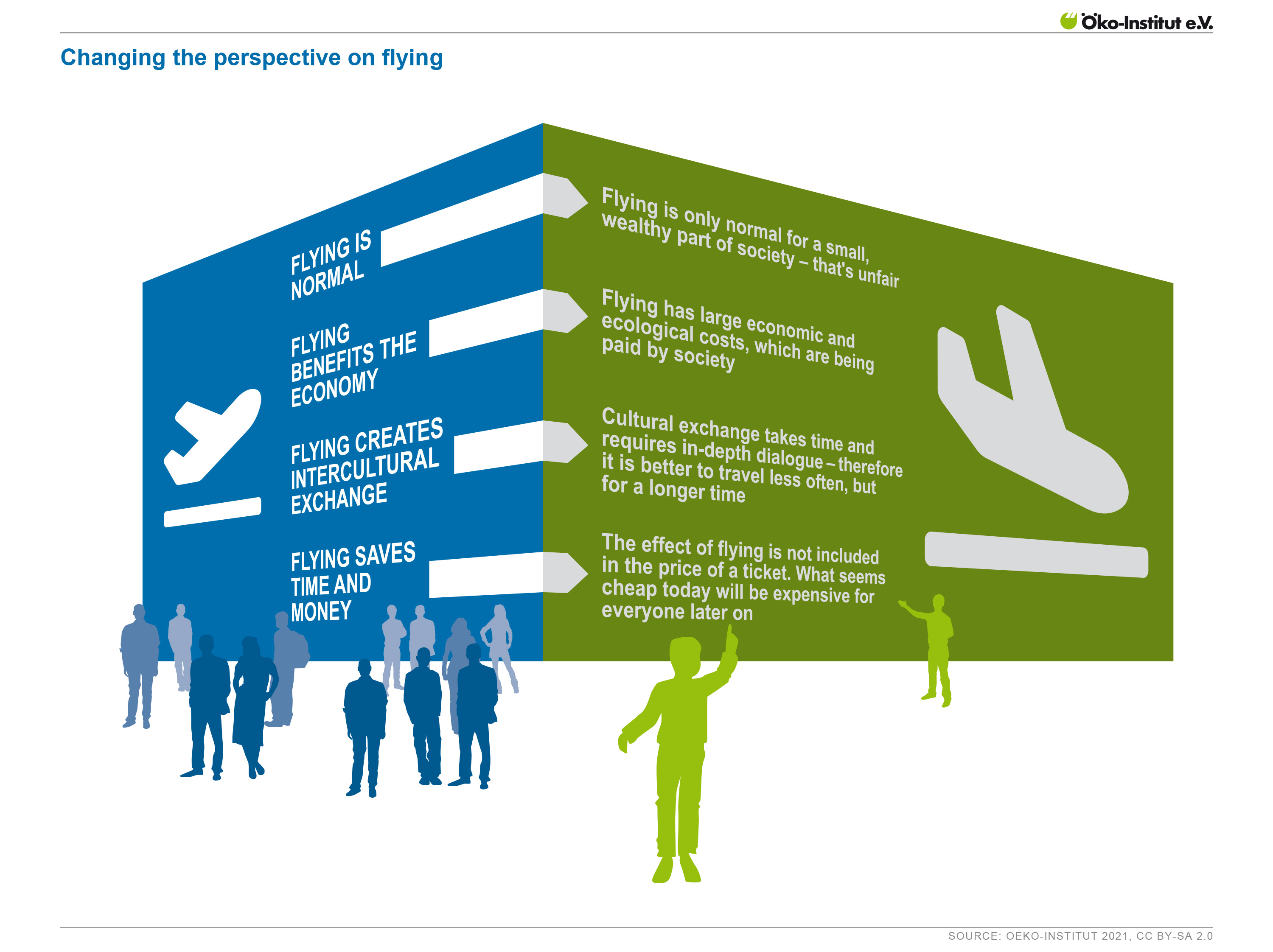
  • Flying and climate protection: rethinking necessary

    Flying is associated with a positive image. But many of the things we "commonly" think can be seen differently. The infographic highlights this. For example, the attitude: "Flying is normal - everyone flies." Contrast that with: Flying is reserved for a small group of privileged people. Even in Germany, six percent of the population rarely or never fly, and of those on low incomes, as many as 83 percent fly little or not at all. And only a small proportion of humanity has ever even sat in an airplane. How often people fly therefore strongly depends on their income. Conversely, this means that people with high incomes who fly more than people with lower incomes benefit the most from subsidies for air travel.
    Further information: http://www.fliegen-und-klima.de/en

    Flying and climate protection: rethinking necessary

    Image06/01/2021722.30 KB
    Flying is associated with a positive image. But many of the things we "commonly" think can be seen differently. The infographic highlights this.
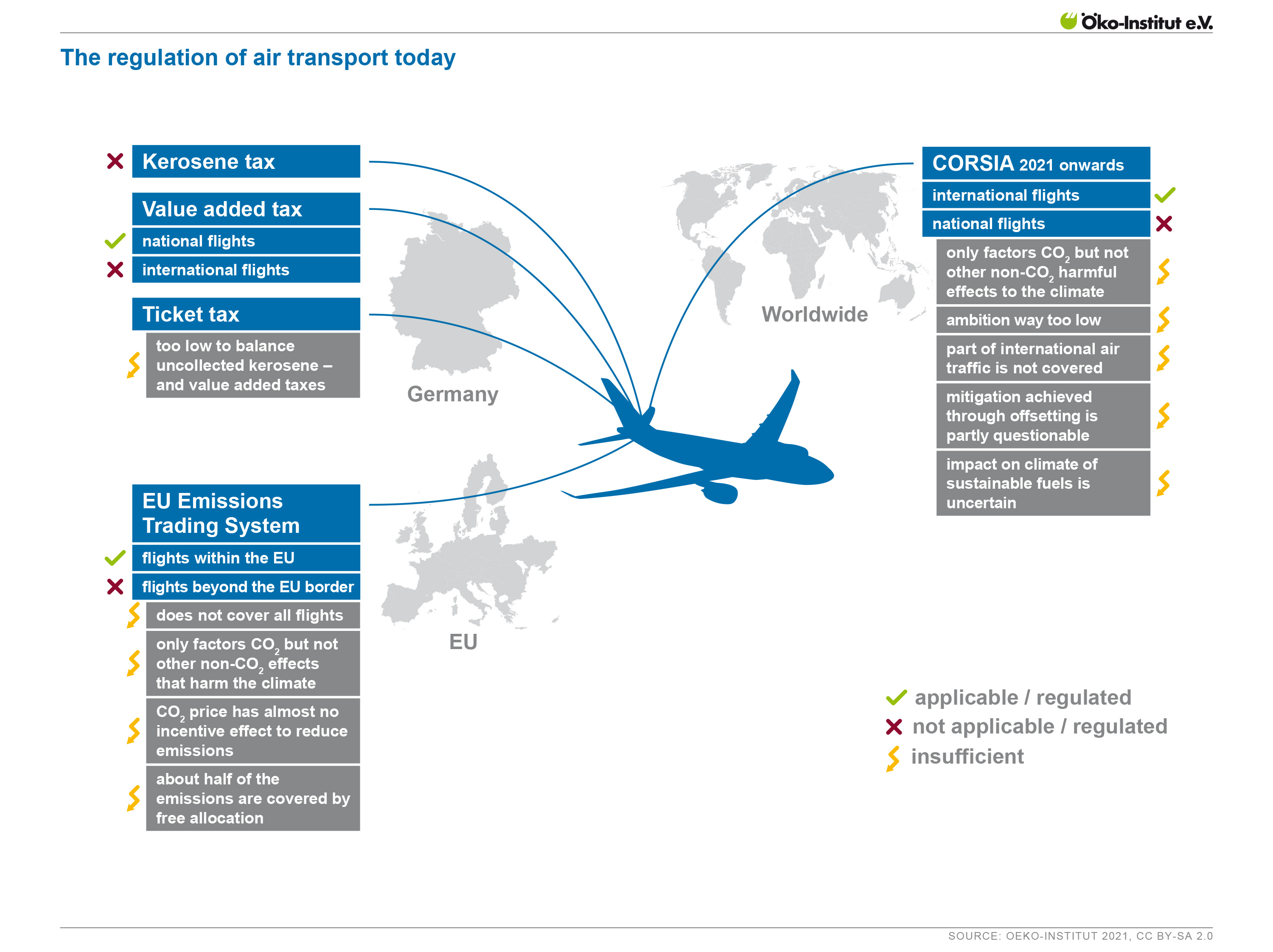
  • Flying and climate protection: The regulation of air traffic today

    Flying is cheap. And that is precisely why it is so attractive. But how is it possible that getting around by plane is so cheap compared to other modes of transport - despite its immensely damaging effect on the climate? The answer is: Unlike most other modes of transportation, air travel is only lightly regulated. Other modes of transport are charged with significantly higher levies. Germany alone subsidizes the airline industry with around 12 billion euros a year. Thus, the price of an airline ticket does not reflect the high ecological costs caused by air traffic.
    The infographic shows the status of regulation via taxes in Germany, as well as emissions trading in the EU and the international agreement CORSIA. It shows deficits and inadequacies in regulation that contribute to the fact that aviation has so far failed to make a contribution to climate protection.

    Further information: http://www.fliegen-und-klima.de/en

    Flying and climate protection: The regulation of air traffic today

    Image06/01/2021781.14 KB
    Flying is cheap. And that is precisely why it is so attractive. But how is it possible that getting around by plane is so cheap compared to other modes of transport - despite its immensely damaging effect on the climate? The answer is: Unlike most other modes of transportation, air travel is only lightly regulated.
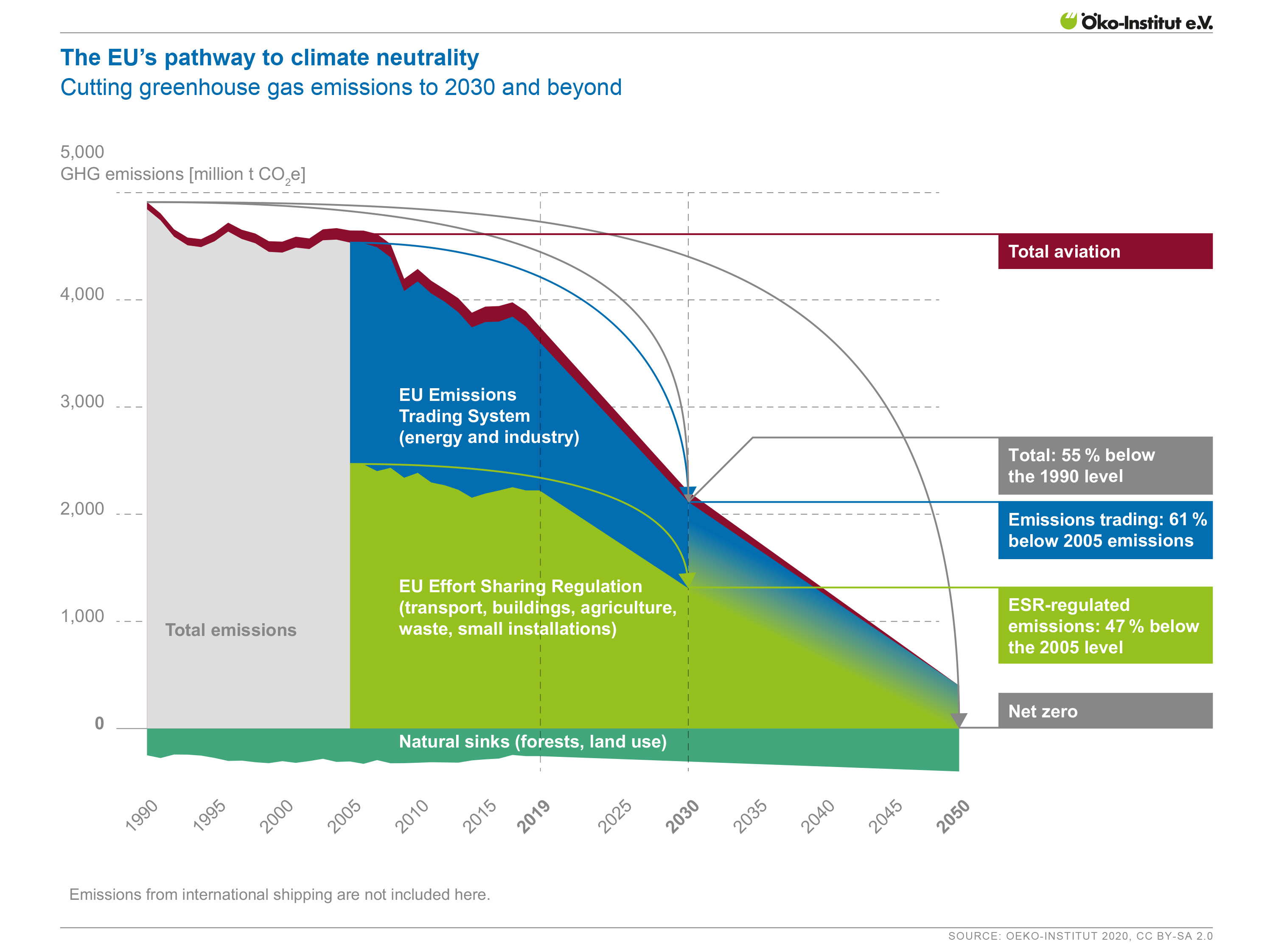
  • The EU's pathway to climate neutrality

    The EU aims to be climate-neutral by 2050. This means that total residual emissions should not be higher than the CO2 permanently sequestered from the atmosphere by forests, etc.
    In moving towards this goal, the EU’s current climate target for 2030 – to reduce greenhouse gas emissions by 40 per cent compared with the 1990 baseline – must be raised to -55 per cent at minimum. It is also important to ensure that there are no loopholes that would lead to a softening of the target, such as international compensation measures. What’s more, the journey is as important as the destination: fast action to reduce emissions now will substantially lower overall emissions to 2050.
    More information on our website: https://www.oeko.de/en/up-to-date/more-climate-ambition-in-the-eu-and-germany-needed-now

    The EU's pathway to climate neutrality

    Image01/29/2021718.48 KB
    The EU aims to be climate-neutral by 2050. This means that total residual emissions should not be higher than the CO2 permanently sequestered from the atmosphere by forests, etc. In moving towards this goal, the EU’s current climate target for 2030 – to reduce greenhouse gas emissions by 40 per cent compared with the 1990 baseline – must be raised to -55 per cent at minimum.
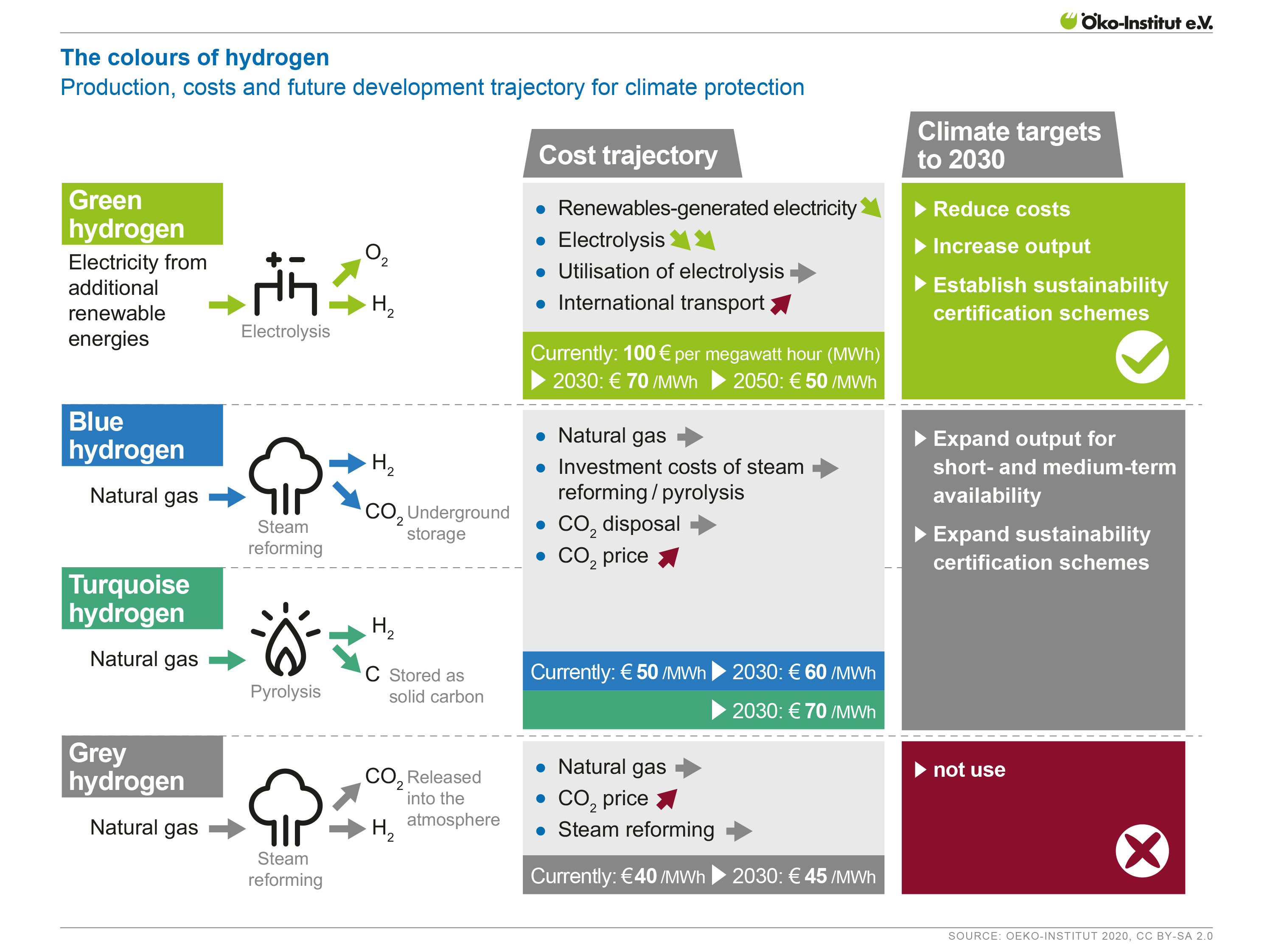
  • The colours of hydrogen

    The graphic shows the different production paths of hydrogen. For example, "green hydrogen" is produced on the basis of renewable electricity; oxygen is produced during electrolysis. Blue hydrogen" uses natural gas; CO2 is released during the production process, which has to be captured and stored. "Turquoise hydrogen" also uses natural gas, coal is produced as a residual product of pyrolysis.

    Depending on the starting material and the process for climate protection, hydrogen can contribute to climate protection and thus become the fourth pillar for the energy transition.

    In addition, the graph shows the cost components of the different hydrogen production paths and their expected development. It becomes clear that emission-free hydrogen remains a relatively expensive energy carrier even with massive cost reductions.

    For more information: https://www.oeko.de/en/up-to-date/2020/hydrogen-a-comprehensive-review

    The colours of hydrogen

    Image01/12/2021875.31 KB
    The graphic shows the different production paths of hydrogen. For example, "green hydrogen" is produced on the basis of renewable electricity; oxygen is produced during electrolysis. Blue hydrogen" uses natural gas; CO2 is released during the production process, which has to be captured and stored. "Turquoise hydrogen" also uses natural gas, coal is produced as a residual product of pyrolysis.
  • The end of the internal combustion engine

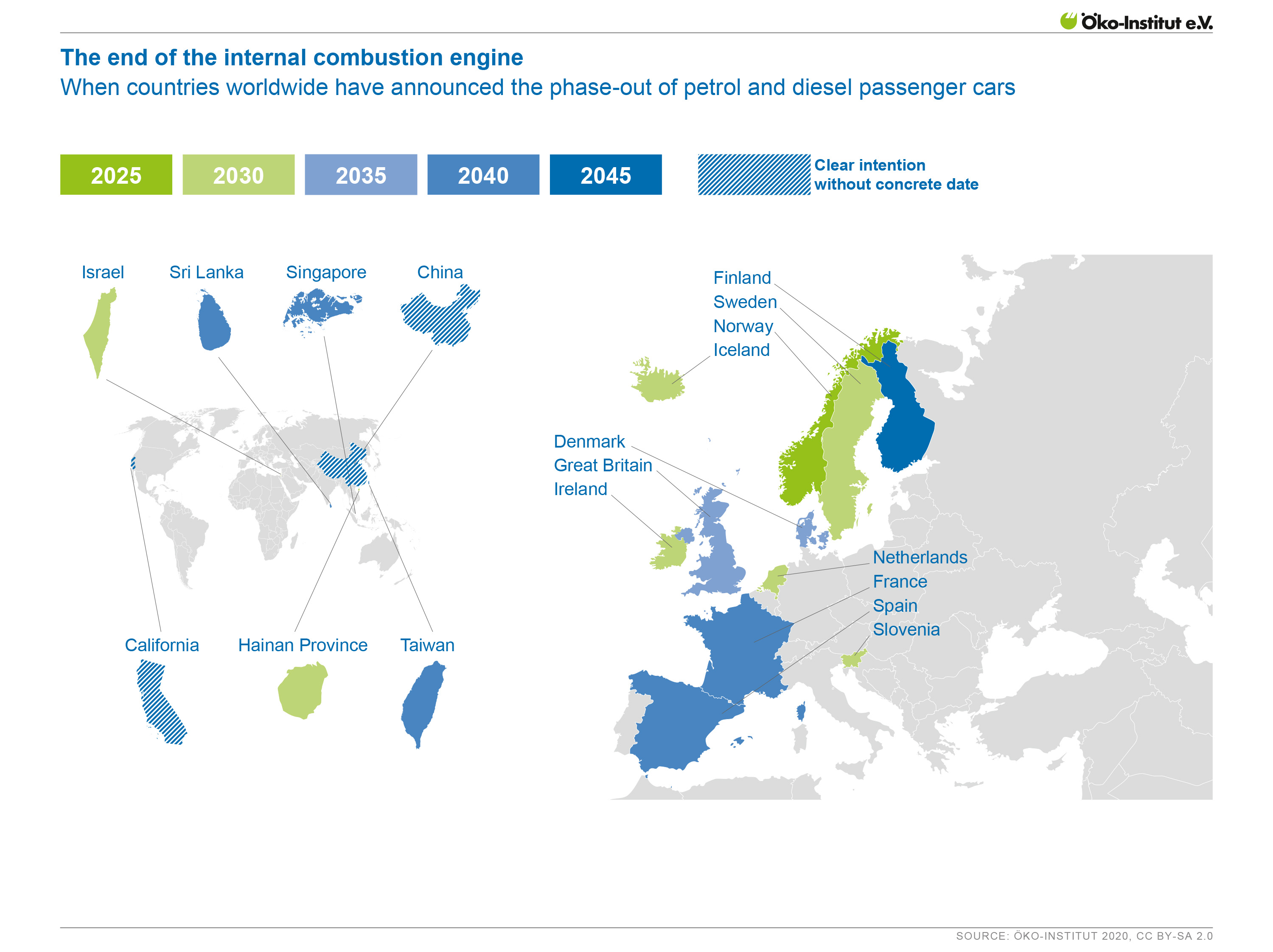
    The farewell to the combustion engine is foreshadowed in large parts of road traffic: Major states and regions have set themselves the goal of no longer permitting new combustion engines after a certain year, usually between 2025 and 2040, or even of equipping their vehicle fleets completely with alternative drive systems.

    The end of the internal combustion engine

    Image09/08/2020763.04 KB
    The farewell to the combustion engine is foreshadowed in large parts of road traffic: Major states and regions have set themselves the goal of no longer permitting new combustion engines after a certain year, usually between 2025 and 2040, or even of equipping their vehicle fleets completely with alternative drive systems.
  • The CO2 footprint of our digital lifestyle

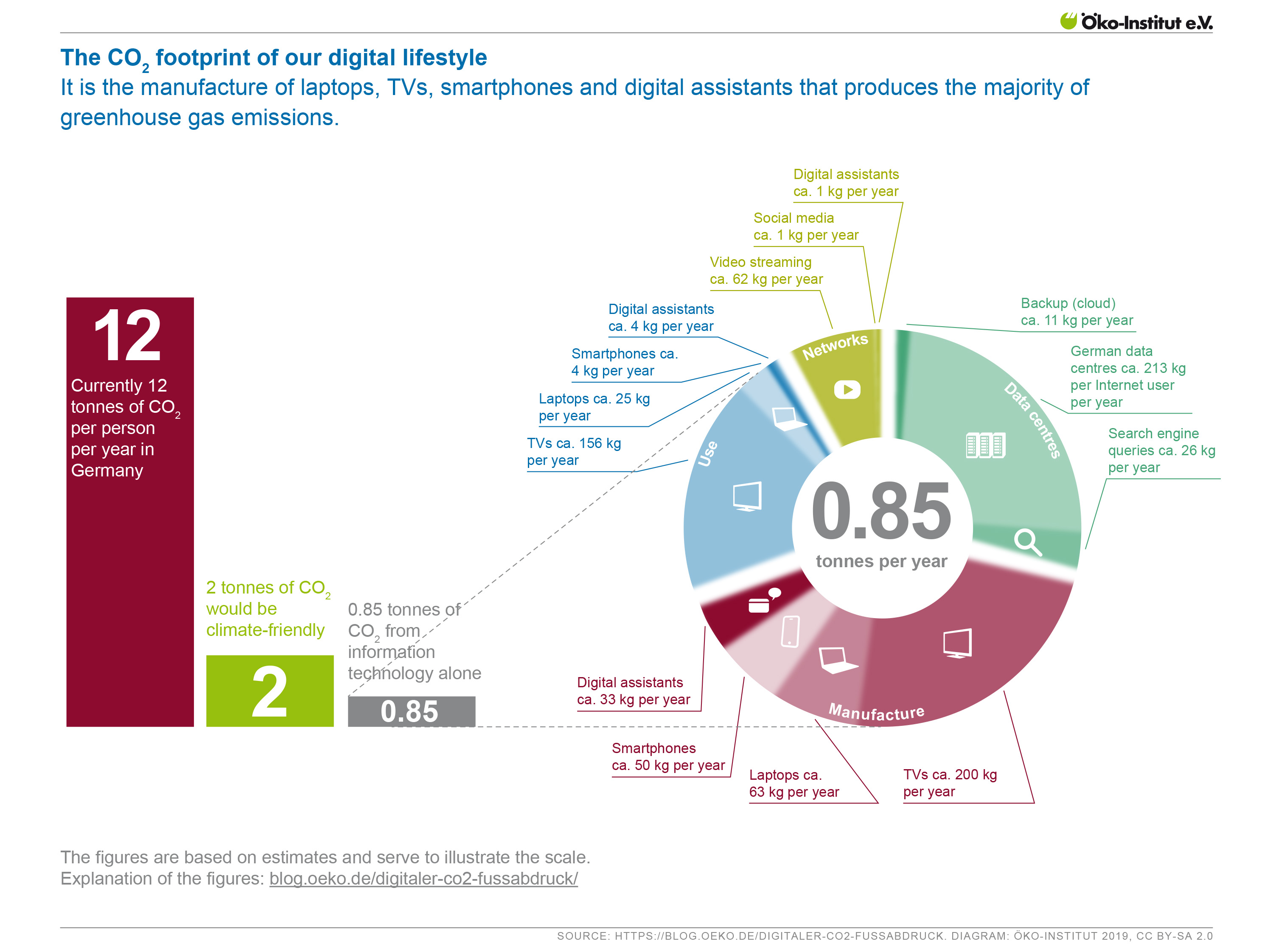
    What are the CO2 emissions of a Google search? In response to this popular question a researcher at the Oeko-Institut set out to calculate how digitalisation affects the climate – or at least illustrate the scale of the issue. The problem is that some of the figures are fraught with uncertainty – partly because they are changing rapidly as a result of technological progress and changing consumer habits and because they depend heavily on structural conditions (such as how the electricity is generated). Nevertheless, the researcher used some number games and “rule of three” calculations to demonstrate the scale of the problem. The figures were generously rounded to avoid pretending to a degree of accuracy that unfortunately does not exist.

    To give a general idea: through energy use, transport and consumption, someone living in Germany generates around 12 tonnes of CO2-equivalent emissions (CO2e) per year. A climate-friendly level would be two tonnes for every person on Earth.

    Link to a detailed blog post with all the facts: blog.oeko.de/digitaler-co2-fussabdruck/#english

    The CO2 footprint of our digital lifestyle

    Image04/27/2020793.16 KB
    What are the CO2 emissions of a Google search? In response to this popular question a researcher at the Oeko-Institut set out to calculate how digitalisation affects the climate – or at least illustrate the scale of the issue.
  • Power-to-X: How much power is left

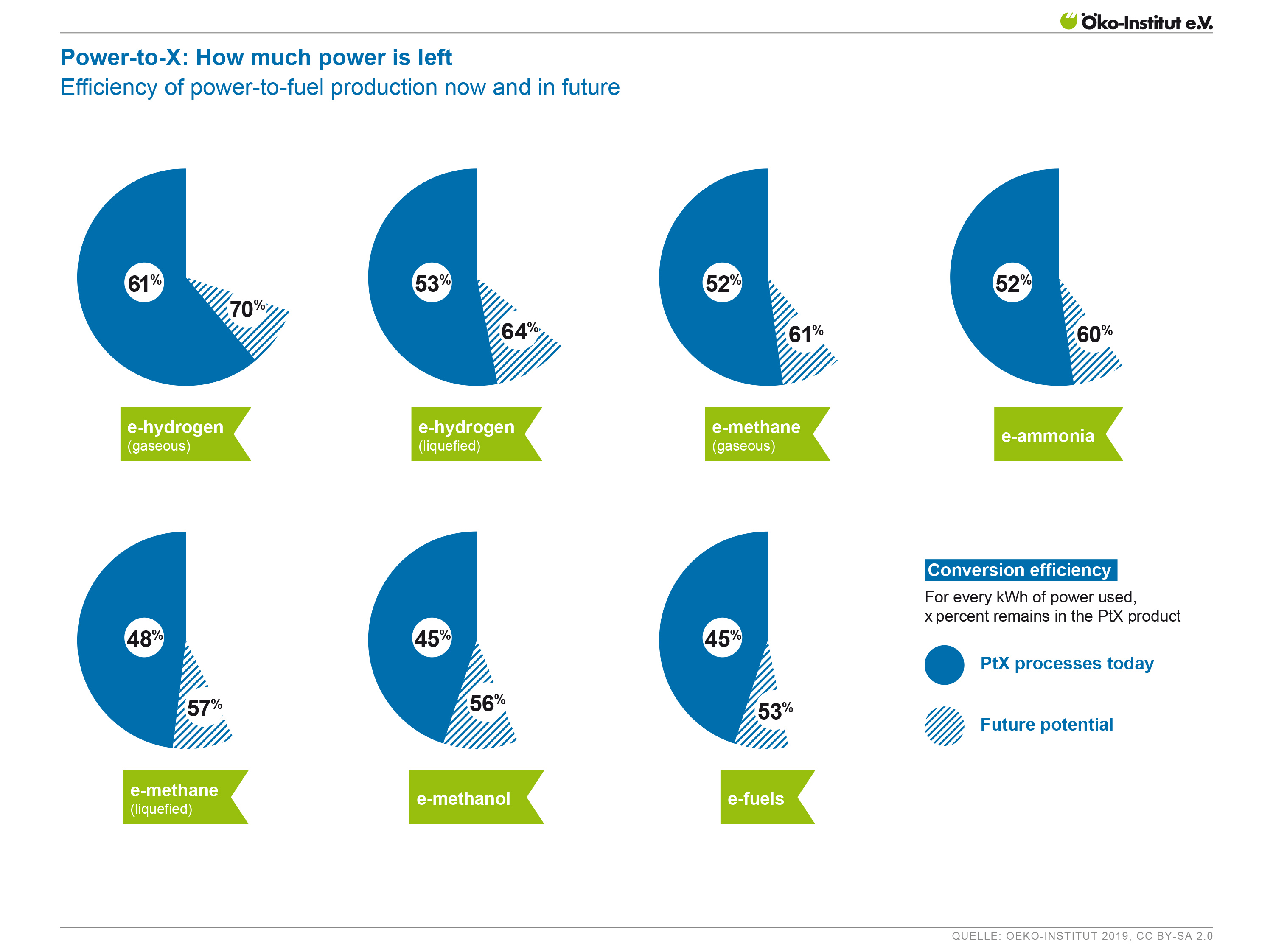
    Efficiency of power-to-fuel production now and in future

    Power-to-X: How much power is left

    Image09/09/2019968.78 KB
    Efficiency of power-to-fuel production now and in future
  • When replacement of products pays off from an environmental point of view – Using electronic products for longer periods or replacing them prematurely with more energy-efficient appliances

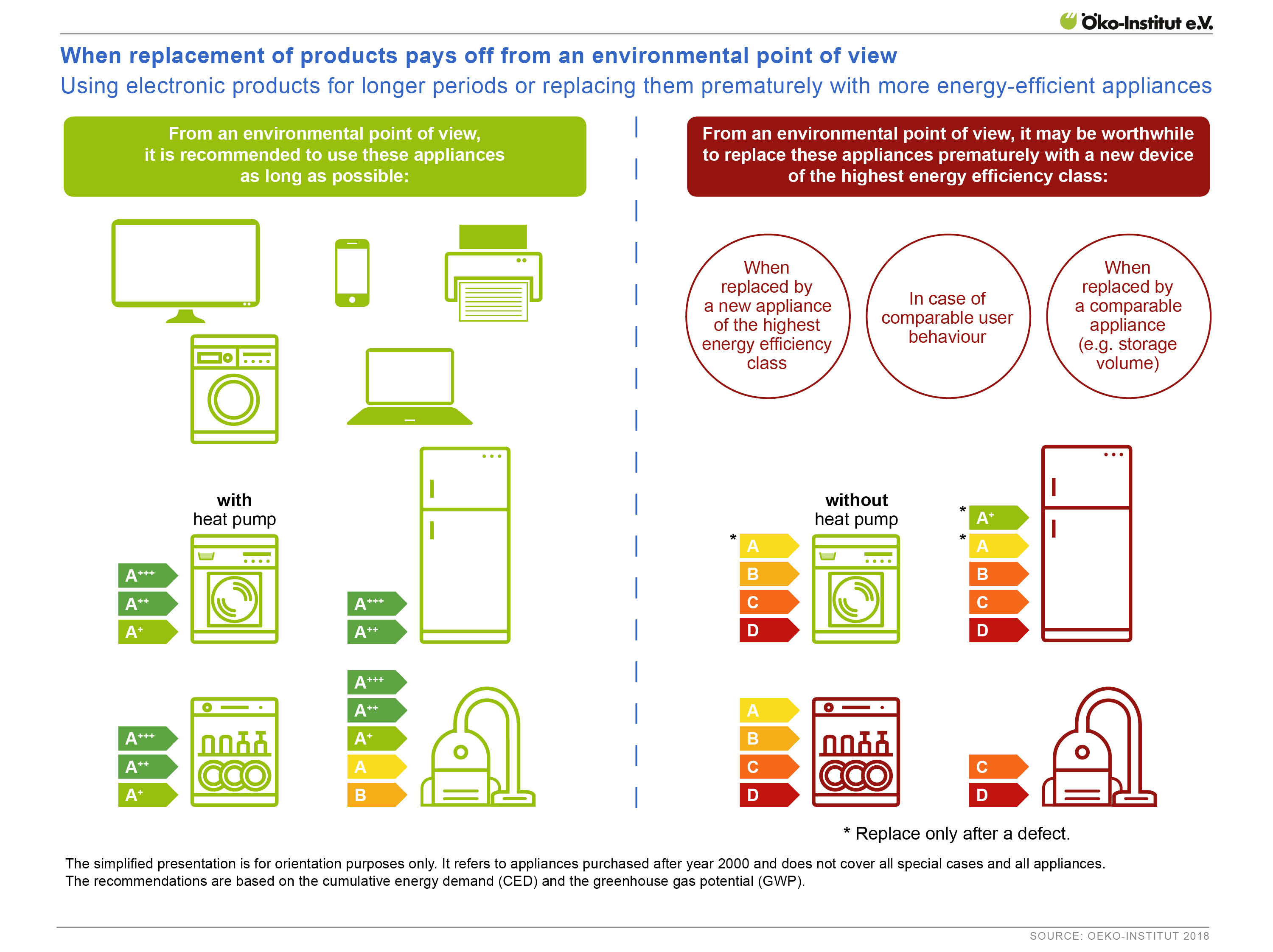
    The chart shows the appliances that should be used as long as possible from the environmental perspective (left-hand side). The fundamental principle is: From an environmental point of view, it is advisable, with a few exceptions, to repair defective household appliances and extend their total use-time. This saves energy and resources that are used in the manufacturing of new products.

    The right-hand side of the chart shows the appliances where an early replacement with a new appliance from the highest energy efficiency class may be appropriate. In addition to the energy efficiency class, it is important that the new appliance is not larger than the old one and that it is used in a similar pattern.

    The simplified presentation is for orientation purposes only. It refers to appliances purchased after year 2000 and does not cover all special cases and all appliances. The recommendations are based on the cumulative energy demand (CED) and the greenhouse gas potential (GWP).

    When replacement of products pays off from an environmental point of view – Using electronic products for longer periods or replacing them prematurely with more energy-efficient appliances

    Image10/15/2018536.48 KB
    The chart shows the appliances that should be used as long as possible from the environmental perspective (left-hand side). The fundamental principle is: From an environmental point of view, it is advisable, with a few exceptions, to repair defective household appliances and extend their total use-time. This saves energy and resources that are used in the manufacturing of new products.