Focus

Waste management

© plainpicture / Stefanie Grewel

From waste prevention, reuse and recycling to disposal – the waste management sector applies a multitude of strategies. However, the potential to recover and reuse the raw materials and valuable resources found in waste is still not being utilised to the full. All too often, waste is incinerated or sent to landfill instead of being made available for high-quality recycling – even though this form of recycling can help to mitigate climate change. For example, if plastics – which are manufactured from oil – are not recycled properly but are incinerated in inefficient base-load power plants, they produce high carbon emissions, which will not be offset by relevant benefits in future.

With separate collection, sorting and treatment, the valuable resources found in waste can be recovered and climate-damaging greenhouse gas emissions reduced. The Oeko-Institut works on various aspects of waste management, from prevention to recycling. The experts undertake comparative analyses of various technological and regulatory approaches and develop recommendations for policy-makers and businesses in order to promote the most sustainable alternatives.

News

Infographics

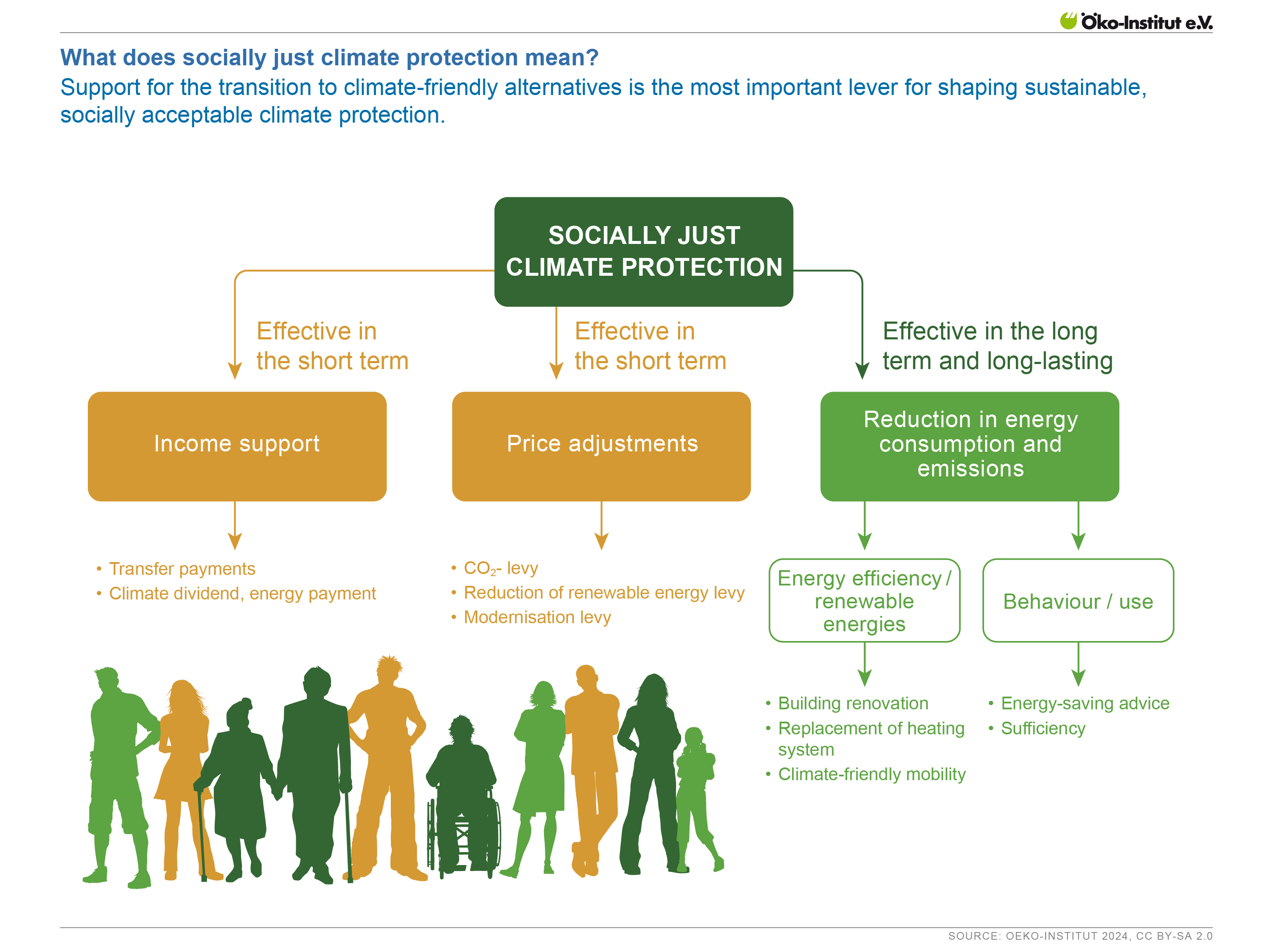
  • Infographic from Öko-Institut e.V. titled "What does socially just climate protection mean?" showing strategies for sustainable, socially acceptable climate protection. Central box labeled "Socially Just Climate Protection" connects to three approaches:  Income support (short-term):  Includes transfer payments, climate dividends, and energy payments.  Price adjustments (short-term):  Includes CO₂ levy, reduction of renewable energy levy, and modernization levy.  Reduction in energy consumption and emissions (long-term and lasting):  Split into two areas:  Energy efficiency / renewable energies: building renovation, heating system replacement, climate-friendly mobility.  Behaviour / use: energy-saving advice and sufficiency.  Silhouettes of diverse people are shown at the bottom, representing the inclusive impact of these measures.

    What does socially just climate protection mean?

    Image10/21/2025
    What does socially just climate protection mean? Support for the transition to climate-friendly alternatives is the most important lever for shaping sustainable, socially acceptable climate protection.
  • The twelve largest chemical parks in German industry

    Image07/08/2024
    The twelve largest German chemical parks generated 23 million tonnes of CO2 (mt CO2) in 2022, which corresponds to three percent of German greenhouse gas emissions.
  • Coastal Ecosystems: Blue Carbon Storage

    Image05/29/2024
    Seagrass meadows, mangrove forests and salt marshes can absorb and store up to 216 million tons of carbon from the atmosphere worldwide every year. Over centuries to millennia, they form an enormous carbon store of up to 22,000 million tons of carbon in marine sediment. At the same time, they make an important contribution to the preservation of biodiversity in the oceans and on the coasts, help to protect against storm surges and coastal protection and thus contribute to the nutrition and safety of millions of people. This is shown in a research report by the Öko-Institut and the Leibniz Center for Tropical Marine Research commissioned by the German Environment Agency, which examines the importance of coastal ecosystems for global climate protection.