Spenden
Focus

Circular economy

© plainpicture / Astrakan Images

The circular economy involves more than waste management: the aim is to create closed loops for raw materials and slow down substance cycles altogether. A circular economy recognises concepts such as waste prevention, reuse and repair. It starts with product design and encompasses manufacturing, (re)use and recycling. It also includes measures that lengthen product lifespans and service life, such as minimum durability requirements and, not least, sufficiency: this means consuming less and reducing energy and resource use.

A circular economy is nothing less than a new economic model – a structural transformation in line with environmental principles and a paradigm shift at the same time. It is also a key field of action in the transition to sustainability as it is relevant not only to greenhouse gas emissions but also to biodiversity loss and resource consumption. The Oeko-Institut conducts in-depth analyses of the various approaches and the economic, technological and social challenges associated with the circular economy and develops policy solutions for all levels.

News

Infographics

  • Civilisation’s gold – the potential of urban mining

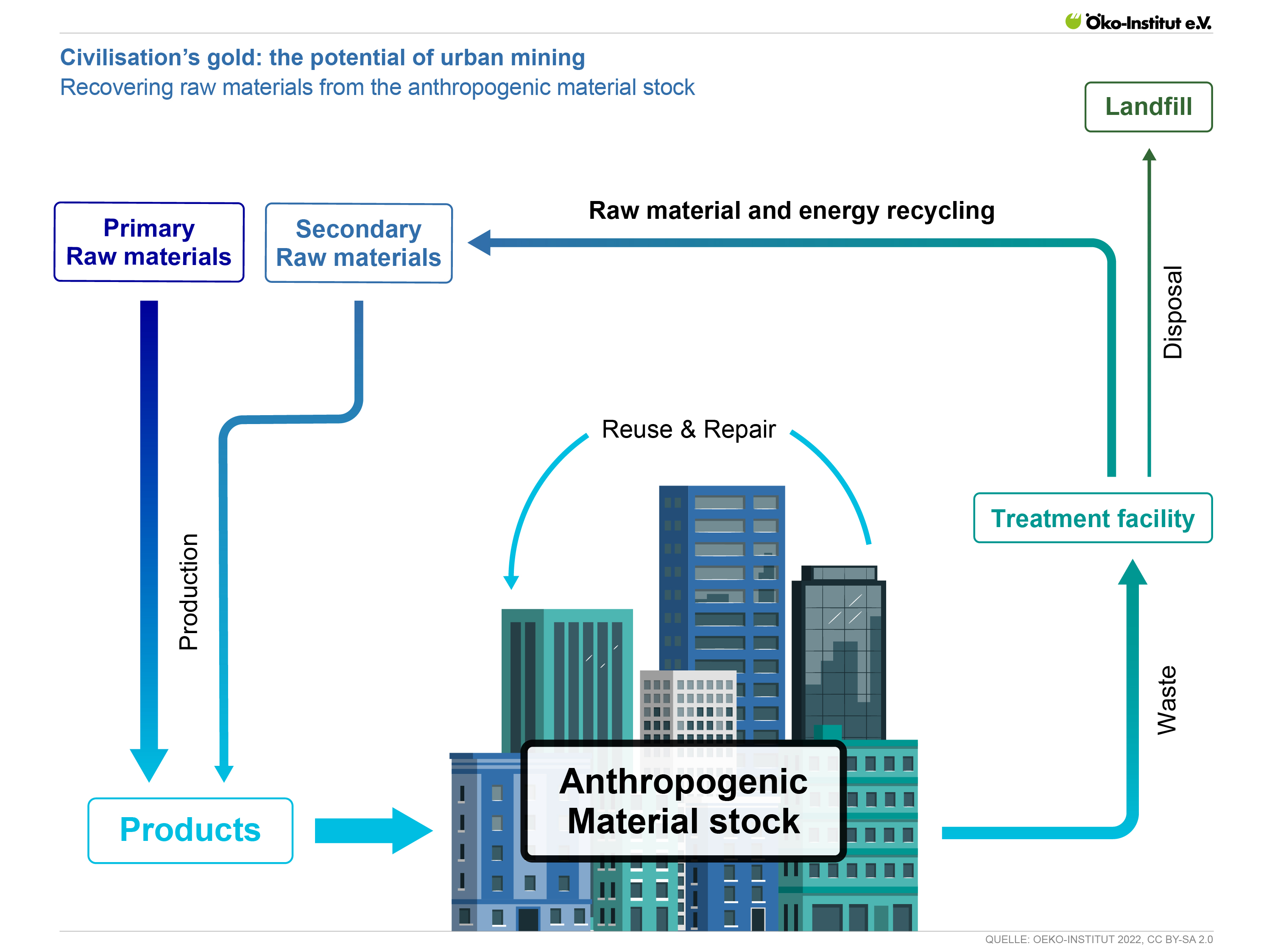
    This figure explains the urban mining cycle: the anthropogenic material stock – created by human activity – is the source of raw materials for future use. Waste products from this stock, such as cutlery, cables and passenger cars, are scrapped and taken to recycling plants. The non-recyclable components are sent to landfill, while the rest of the waste is recycled, with recovery of raw materials and energy. The secondary raw materials that are recovered can be processed into new products and are fed back into the anthropogenic material stock. At present, large quantities of new (i.e. newly extracted) primary raw materials are entering the production process. In future, a substantial proportion of such materials will come from the anthropogenic material stock itself.<br> Further information can be found in the blog article Civilisation’s gold: https://blog.oeko.de/civilisations-gold-first-ever-mapping-of-the-urban-mining-potential-to-2040/

    Civilisation’s gold – the potential of urban mining

    Image09/29/2022
    This figure explains the urban mining cycle: the anthropogenic material stock – created by human activity – is the source of raw materials for future use.
  • The anthropogenic metals stock is growing

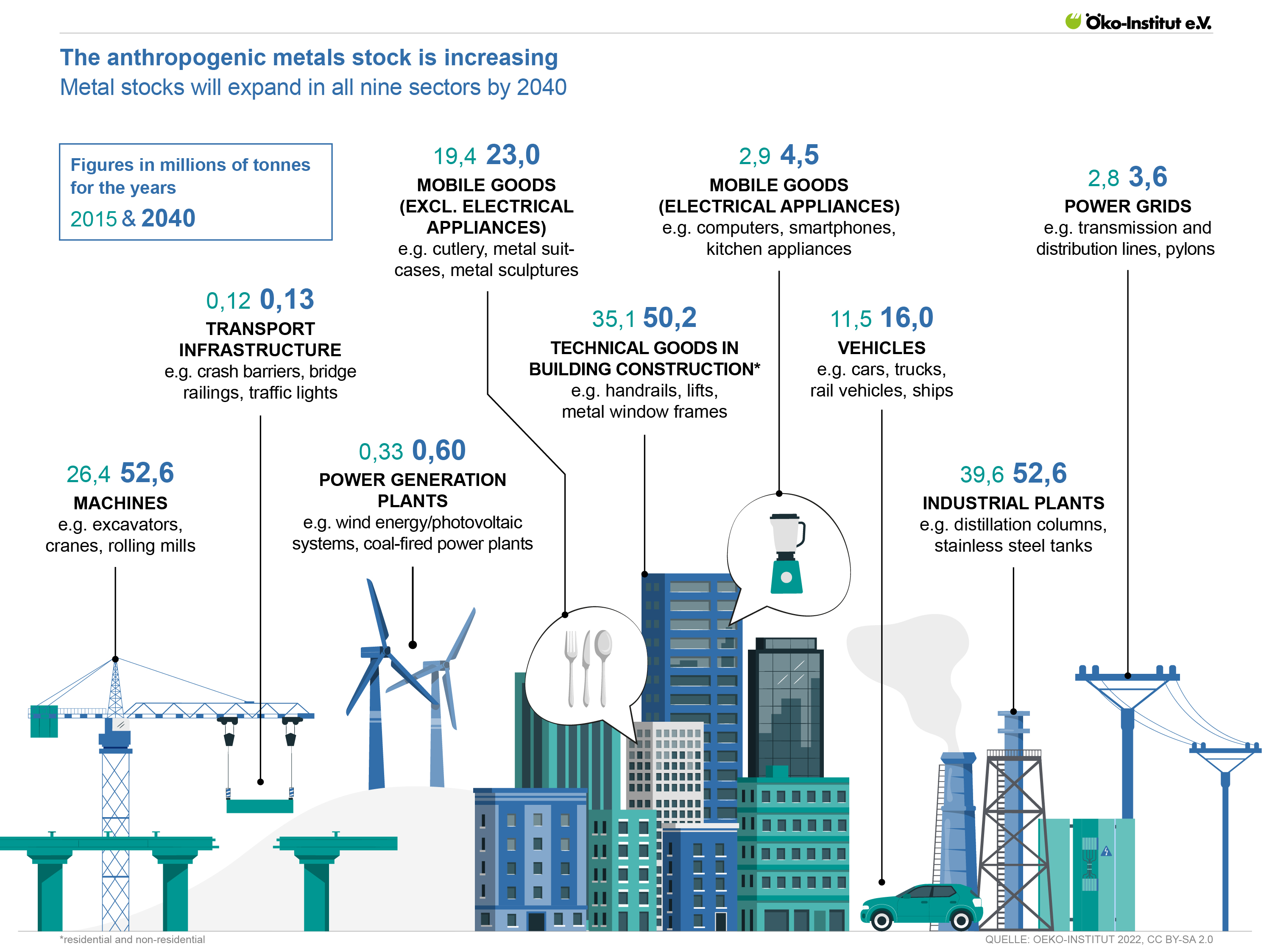
    This figure illustrates the anthropogenic metals stock. It is fed by nine sectors: technical goods in building construction, mobile goods in buildings (excluding electrical appliances), mobile goods in buildings (electrical appliances), power generation plants, power grids, vehicles, transport infrastructure, industrial plants, and machines. Researchers from the Oeko-Institut have now conducted the first-ever mapping of this stock, with a focus on the following metals: aluminium (non-ferrous metal); magnesium (non-ferrous metal); zinc (non-ferrous metal); tin (non-ferrous metal); stainless steel (non-ferrous metal); brass (alloy); neodymium-iron-boron magnetic materials / rare earths (alloy). As the stock of all these metals is set to increase substantially by 2040, it can serve as a source of raw materials in future.
    Further information can be found in the blog article Civilisation’s gold: https://blog.oeko.de/civilisations-gold-first-ever-mapping-of-the-urban-mining-potential-to-2040/

    The anthropogenic metals stock is growing

    Image09/29/2022
    This figure illustrates the anthropogenic metals stock. It is fed by nine sectors: technical goods in building construction, mobile goods in buildings (excluding electrical appliances), mobile goods in buildings (electrical appliances), power generation plants, power grids, vehicles, transport infrastructure, industrial plants, and machines.
  • Urban mining – a future source of raw materials

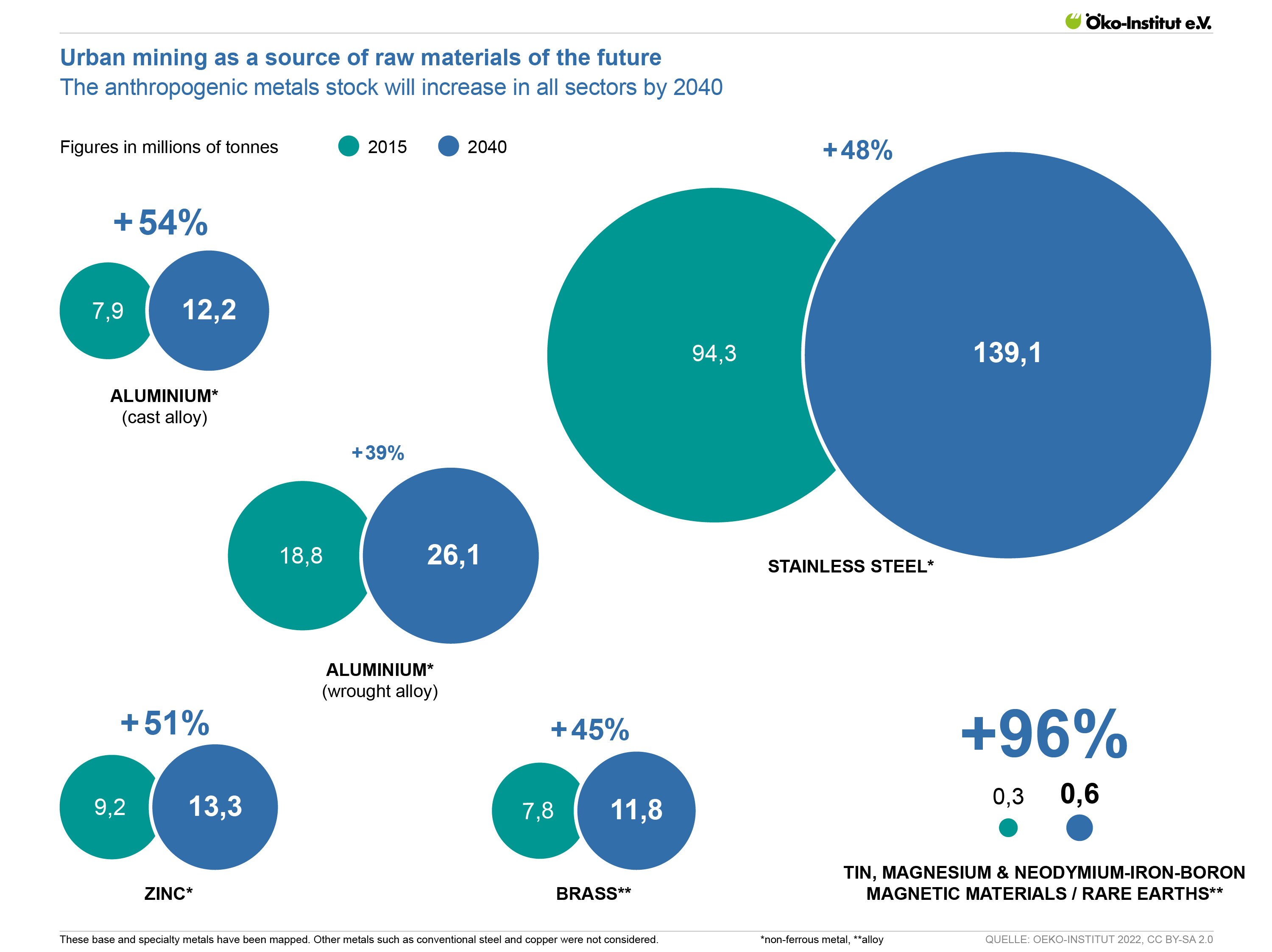
    This figure traces the growth of the various metals in the anthropogenic metals stock – which is created by human activity – to 2040. The stock of all the metals investigated (aluminium (non-ferrous metal); magnesium (non-ferrous metal); zinc (non-ferrous metal); tin (non-ferrous metal); stainless steel (non-ferrous metal); brass (alloy); neodymium-iron-boron magnetic materials / rare earths (alloy)) is expected to increase substantially and will thus serve as a good source of raw materials in future.
    Further information can be found in the blog article Civilisation’s gold: First-ever mapping of the urban mining potential to 2040: https://blog.oeko.de/civilisations-gold-first-ever-mapping-of-the-urban-mining-potential-to-2040/

    Urban mining – a future source of raw materials

    Image09/29/2022
    This figure traces the growth of the various metals in the anthropogenic metals stock – which is created by human activity – to 2040.