Guzman Renovable: How a tiny village is powering Spain’s local energy transition


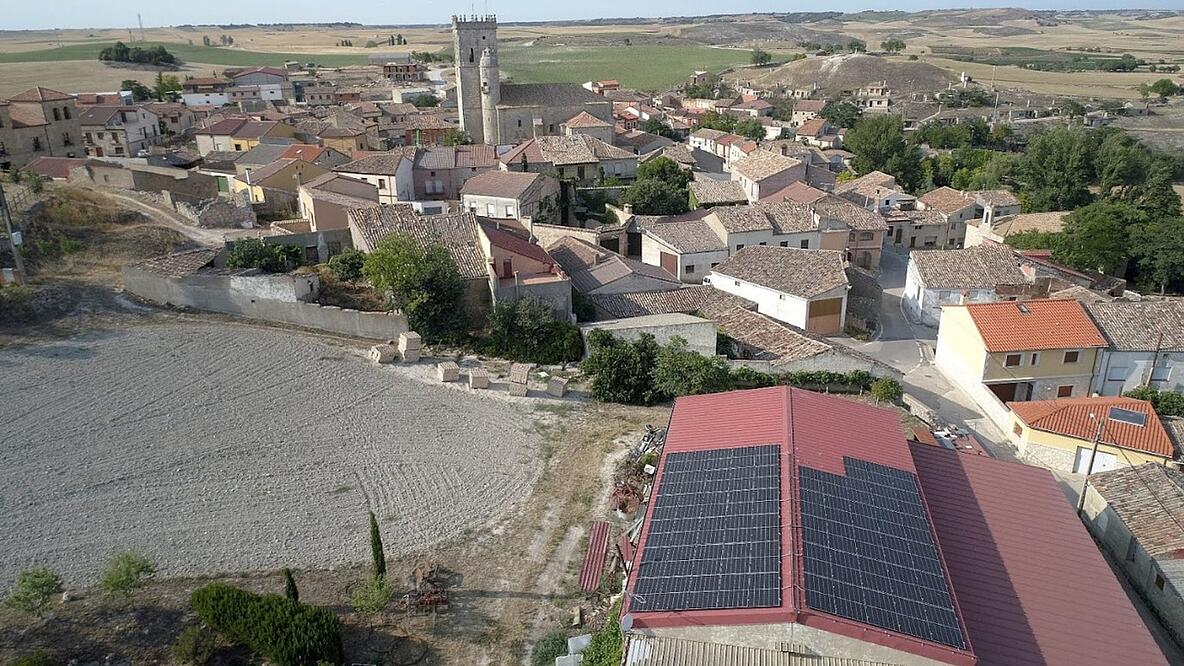

© Sibylle Braungardt
High on the Spanish plateau of Burgos, surrounded by wheat fields and long, empty roads, lies the village of Guzmán, home to fewer than one hundred residents. It is the kind of place often described as part of España vaciada, where services shrink, young people move away and the future feels uncertain. And yet, this tiny community has achieved something many larger towns are still struggling with: it has created one of Spain’s first rural energy communities.
We have just published a new book chapter documenting the journey of Guzman Renovable, showing how a handful of residents transformed their local energy system and became pioneers in the country’s transition toward decentralised renewable generation. The story proves that innovation does not have to come from institutions or cities – it can begin on the rooftops of a village.
From a local idea to a collective vision
The seed of the project was planted during the COVID-19 pandemic, when residents worked together to improve the energy efficiency of communal buildings. Their successful retrofit of the town hall convinced them that a more ambitious step was possible. In early 2022, they founded Guzman Renovable as a non-profit association, determined to produce renewable electricity locally and share its benefits fairly. The initiative grew from within the community itself, supported by collaboration with the University of the Basque Country, the cooperative Energetica Coop and the local council.
How collective self-consumption works in Guzmán
At the heart of the project is a 30.3 kWp shared photovoltaic installation mounted on a municipal roof. Rather than each household installing its own solar panels – which would be costly, uneven and spatially limited – the community chose Spain’s model of collective self-consumption.
This means that a single installation generates electricity that is divided among participating households through predefined allocation coefficients. These “keys of repartition” determine how much of the generated energy each member receives. In Guzmán, they were calculated using two years of hourly consumption data for each household, ensuring that distribution reflects real energy use as closely as possible. The system prioritises maximising local self-consumption, reducing surpluses to the grid and helping households benefit directly from the solar energy produced during peak daylight hours.
This shared approach allows fourteen households, two small businesses and the town hall to participate in the project. It optimises the use of space, reduces investment costs per participant and encourages cooperation rather than competition. The success has already prompted the development of a second shared installation for ten more households.
A difficult path to connection
While the technical concept was clear from the start, the administrative reality was far more complicated. Securing grid connection approval proved to be the most significant obstacle. The energy community had to wait more than a year for the distribution company to process the connection request, despite the PV panels already installed on the roof. The delay stemmed from slow procedures, unclear responsibilities and a lack of tailored processes for small energy communities.
A model for rural innovation
Despite these hurdles, Guzman Renovable is now fully operational and has already received the Fuentes Claras Award for its contribution to rural sustainability. It demonstrates that small villages can be laboratories of innovation, capable of designing fair energy-sharing mechanisms, mobilising local participation and building long-lasting renewable infrastructure.
The lessons from Guzmán are clear. Rural communities can play a key role in Spain’s climate transition, but they need a supportive framework: faster grid access, simpler permitting and consistent regulatory guidance. With these in place, many more villages could follow in Guzmán’s footsteps.
Looking ahead
Spain’s early adoption of collective self-consumption provides a valuable example for other countries: with the right framework, even small villages can successfully develop shared renewable energy systems
Dr Sibylle Braungardt is Head of the Heating & Efficiency subdivision and Senior Researcher at Oeko-Institut. Her research focuses on the green transition of the heating sector.
Further information
Book chapter “Empowering rural Spain: Lessons from Guzman renovable’s energy transition”


